
Valencia’s history: from the Romans to the present day
Valencia’s history stretches back more than 2,000 years. The Romans founded the city; under Muslim rule it continued to develop as Balansiya, and in 1238 King James I made it the centre of the Kingdom of Valencia. Buildings, squares and street names in the old town still show how these eras shaped modern Valencia.
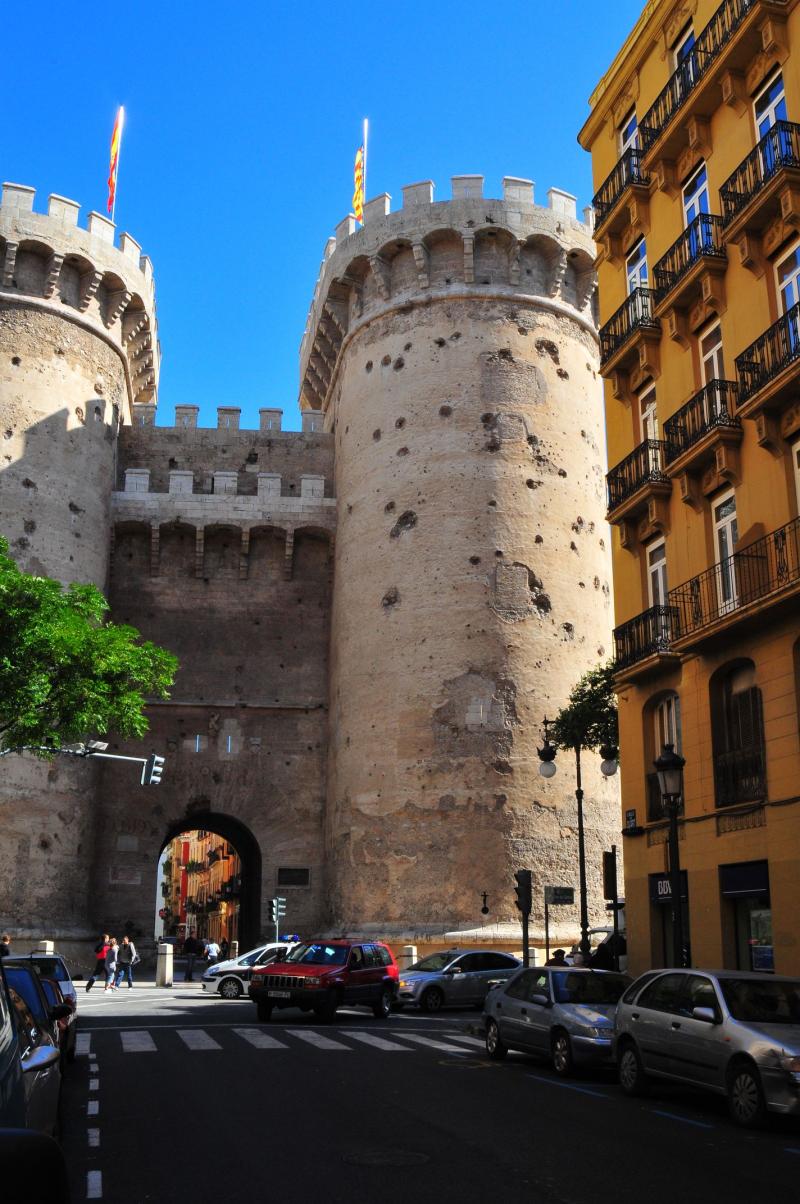 Die mittelalterlichen Torres de Quart in Valencia mit sichtbaren Spuren früherer Belagerungen.
Photo: Alesia Belaya
Valencia history at a glance
- Roman foundation: Valencia was founded in 138 BC as the Roman colony Valentia Edetanorum.
- Muslim Balansiya: From the early 8th century, the city was part of al-Andalus and continued to develop under a succession of rulers.
- El Cid: Rodrigo Díaz de Vivar conquered Valencia in 1094 and ruled the city until his death in 1099; in 1102 it came back under Muslim rule.
- Kingdom of Valencia: James I of Aragon took the city in 1238 and established the Kingdom of Valencia within the Crown of Aragon.
- Golden age in the 15th century: Trade, silk, literature and art made Valencia an important Mediterranean city.
- Loss of its own rights: After the War of the Spanish Succession, Valencia’s special rights were abolished in 1707 by the Nueva Planta decrees.
- A defining turning point: The severe Turia flood of 1957 led to the river being diverted; the Jardín del Turia was later created in its former riverbed.
Roman foundation and early Christianity
The Romans founded Valentia Edetanorum in 138 BC on a river island near the Mediterranean. Its location on the Turia and along important routes facilitated farming, trade and military control. After being destroyed during the Roman civil wars, the settlement was rebuilt and continued to develop during the imperial period.
Archaeological traces of this first city lie beneath the modern city centre. To explore its early history on site, head to the area around Plaza de la Almoina, where remains from the Roman, Visigothic and Islamic periods can be found. Other historical collections and excavations can be put into context through museums in Valencia.
From Visigothic city to Muslim Balansiya
After the end of Western Roman rule, Valencia became part of the Visigothic Kingdom. In the early 8th century, the city came under Muslim control and became part of al-Andalus as Balansiya. Irrigation systems encouraged cultivation in the fertile surrounding countryside; walls, residential districts, markets and religious buildings transformed the cityscape.
Rule changed hands several times between regional dynasties and larger empires. This long period left its mark on agriculture, place names, cuisine and language. Visitors planning trips to the surrounding area will encounter traces of this history in places such as Xàtiva, whose castle bears witness to successive changes in power.
El Cid and the struggle for Valencia
Rodrigo Díaz de Vivar, known as El Cid, conquered Valencia in 1094 after a long siege. He ruled the city until his death in 1099. His widow, Jimena Díaz, held Valencia until 1102, when the city was abandoned and came back under Muslim rule.
The historical figure and the heroic legends told about him later are not the same thing. Medieval sources, the epic poem Cantar de mio Cid and later portrayals shaped different images of the Castilian knight. The page on El Cid and Valencia explains his connection to the city in more detail.
The conquest of 1238 and the Kingdom of Valencia
On 9 October 1238, James I of Aragon entered Valencia. The city became the political centre of the newly established Kingdom of Valencia within the Crown of Aragon. Its own laws, the Furs de València, governed important areas of public life for centuries.
The Christian conquest brought far-reaching changes to governance, religion, property and the population structure. Muslim and Jewish communities initially remained part of society, but faced various restrictions and later increasing persecution. Find out more in the article on the Kingdom of Valencia.
Valencia’s golden age in the 15th century
Valencia experienced an economic and cultural golden age in the 15th century. Mediterranean trade, finance and the silk industry strengthened the city. Important works of literature in the Valencian language were also produced during this period. The development of Valencian therefore cannot be separated from the history of the kingdom.
The best-known building from this period is the Lonja de la Seda, or Silk Exchange. Its late Gothic columned hall and adjoining buildings are reminders of the importance of trade. UNESCO lists the Lonja de la Seda as a World Heritage Site and explains its historical significance to one of the leading trading cities on the Mediterranean.
From the War of the Spanish Succession to the 19th century
During the War of the Spanish Succession, much of Valencia supported the Habsburg claimant to the throne. After the Bourbon victory at the Battle of Almansa in 1707, King Philip V abolished Valencia’s special rights and institutions through the Nueva Planta decrees. The kingdom no longer continued as an independent political entity.
The Napoleonic Wars reached Valencia in the early 19th century. The Torres de Quart still bear visible damage from the French siege of 1808. Industrialisation, the railway, port expansion and urban growth subsequently changed Valencia considerably. Parts of the medieval city walls were demolished, while the Torres de Quart and Torres de Serranos were preserved.
20th century: the republic, civil war and flood
During the Spanish Civil War, Valencia was the seat of the Republican government from November 1936 to October 1937. Bombing, political persecution, hunger and the subsequent Franco dictatorship shaped the lives of many residents. A travel page can only summarise these experiences; museums, archives and memorial sites offer more in-depth information on site.
On 14 October 1957, the Turia flooded large parts of the city. After the disaster, the river was diverted to flow south of Valencia. The drained former riverbed later became the Jardín del Turia, a long green space that now connects historic neighbourhoods, sports facilities and modern cultural buildings. For guidance on getting around the city, see the practical travel information for Valencia.
Autonomy and the transformation into a modern city
After the end of the Franco dictatorship, the Valencian Community was granted a Statute of Autonomy in 1982. Valencia became the seat of the regional institutions. Restorations in the old town, new cultural attractions and major construction projects changed the city’s appearance, while traditional festivals and regional identity remained visible.
Today, different layers of history can be explored within a short distance of one another: Roman excavations at the Almoina, the cathedral, the Lonja de la Seda, historic market halls, the city gates and the Jardín del Turia. For help finding your way around, see the overview of Valencia city; for ideas for other places, beaches and day trips, see holidays in Valencia. The three provinces and coastal areas are compared under Valencia Region.
Frequently asked questions about Valencia’s history
When was Valencia founded?
The Romans founded Valentia Edetanorum in 138 BC. The modern city developed over successive Roman, Visigothic, Islamic and Christian settlement layers.
Was Valencia a Moorish city?
From the early 8th century until 1238, Valencia was mostly part of territories under Muslim rule, interrupted by El Cid’s rule from 1094 to 1102.
When did El Cid conquer Valencia?
El Cid took Valencia in 1094 and ruled there until his death in 1099. His widow held the city until 1102.
What happened in Valencia in 1238?
James I of Aragon conquered Valencia. The city became the centre of the Kingdom of Valencia within the Crown of Aragon.
Why is the Lonja de la Seda important?
The Silk Exchange represents Valencia’s economic prosperity in the 15th century. Today, the late Gothic building is a UNESCO World Heritage Site.
Why no longer does the Turia flow through its old riverbed?
After the devastating flood of 1957, the river was diverted around the south of the city. The Jardín del Turia was later created in the old riverbed.
