
Granja de Rocamora: Huerta, Churches and Local Traditions
Accommodation in Granja De Rocamora
Granja de Rocamora combines the character of a small municipality with the landscape of the Huerta. The municipality covers 7.2 km² and is characterised by Huerta farmland and Mediterranean flora. As a result, rural landscapes, religious heritage and regional traditions take centre stage here – an interesting complement to a stay with Valencia as another destination.
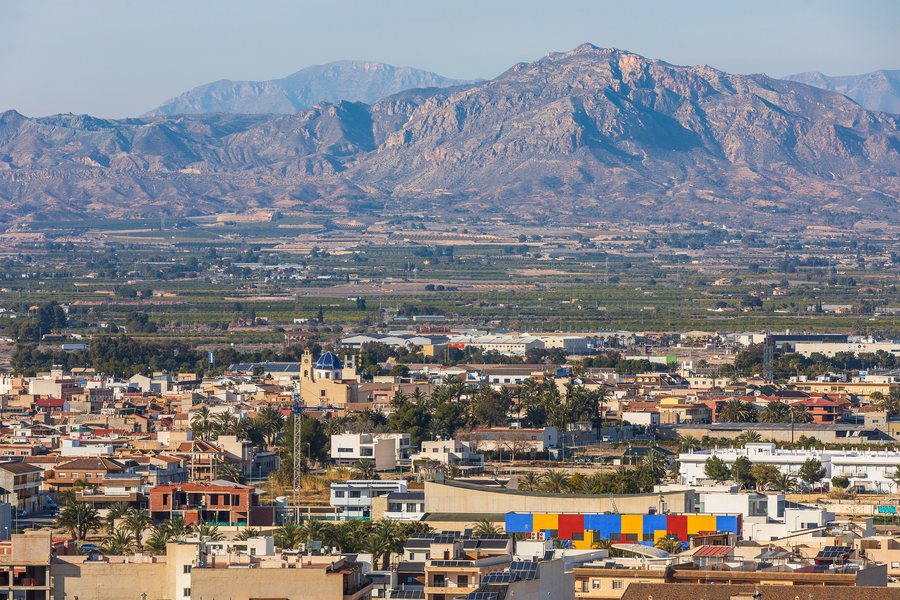 File:Granja de Rocamora from Castillo de Cox, Alicante, Spain, 2025 February - 2.jpg
Photo: Ximonic (Simo Räsänen) via Wikimedia Commons, CC BY-SA 4.0
File:Granja de Rocamora from Castillo de Cox, Alicante, Spain, 2025 February - 2.jpg
Photo: Ximonic (Simo Räsänen) via Wikimedia Commons, CC BY-SA 4.0
Religious Heritage and Historic Buildings
A prominent site is the present-day Ermita Santísima Cruz. It is the third building to have been erected in the same location and dates from 1971. As a religious place of worship, the chapel preserves a relic fragment of the Holy Cross and was renovated in 1996.
The Iglesia de San Pedro Apóstol also represents the town's long architectural and religious history. Its central dome defines the church building; the former altarpiece paintings are now displayed as individual paintings in various places inside the church. The foundation stone was first laid on 29 August 1748. Construction work was completed on 28 July 1775, and the church was consecrated that same day. In addition, the Museo Etnográfico La Santísima Cruz is aimed at school groups and people interested in ethnography.
Paths through the Huerta and Rural Hinterland
The Camino del Lignum Crucis begins in Granja de Rocamora and connects places and churches where a piece of Christ's cross, the Lignum Crucis, is venerated. The Itinerario de los Cabezos offers outdoor environmental activities, hiking, routes and group excursions in the countryside. It also provides landscape experiences and access to the Cabezos, which form part of Granja de Rocamora's historical heritage.
The La Huerta de la Vega route begins at the Ermita de la Santísima Cruz in Granja de Rocamora and passes via the Iglesia de San Pedro Apóstol. Along the way, it passes traditional irrigation facilities of the Vega Baja, including norias, acequias and azarbes. It also connects with the cycle path on the CV-900 and leads into the Huerta of the Vega Baja del Segura. For spatial orientation, the Torre Mora is located about 200 metres from the town on the road towards San Isidro de Albatera.
Festivals, Singing and Community Traditions
The Auroros of the Virgen del Rosario maintain a nocturnal singing tradition in Granja de Rocamora, with processions on the four Sundays in October. Another established period is the Fiestas Mayores de la Santísima Cruz, held from 30 April to 3 May. They include the veneration of a Lignum Crucis relic. On 3 May, this relic is carried in a procession to the Ermita de la Santa Cruz, where the Bendición de los Aires takes place.
Holy Week includes a performance of the Sermón de las 7 Palabras, in which residents of the municipality participate in cooperation with the church. The Romería de las Fiestas de la Exaltación de la Santísima Cruz is also part of the religious calendar: it leads from the Ermita Santísima Cruz to the Granja Escuela La Viña, where a joint day of homage to the Holy Cross takes place. The Granja Escuela is located outside Granja de Rocamora in a Huerta landscape and welcomes school groups for educational and environmental activities.
Regional Cuisine
Local cuisine includes Arroz a la Granjera, a rice dish with broad beans, artichokes and anchovies. Traditional desserts include Tortas de calabaza, Tortas escaldadas and Orejetas.
More Destinations to Compare
La Xara, Orito, Orxeta, Javea, Tibi, El Tosalet, Xaló, Trencall
To the higher-level travel overview: Alicante.

