
Orxeta: Rock Art, Hiking Trails and Local Culture
Accommodation in Orxeta
Orxeta lies in a fertile valley on the Sella River, close to distinctive mountains. Two rock shelters with post-Paleolithic paintings also give the village a particular historical dimension. Between landscapes, trails, religious buildings and festivals, Orxeta presents a multifaceted picture.
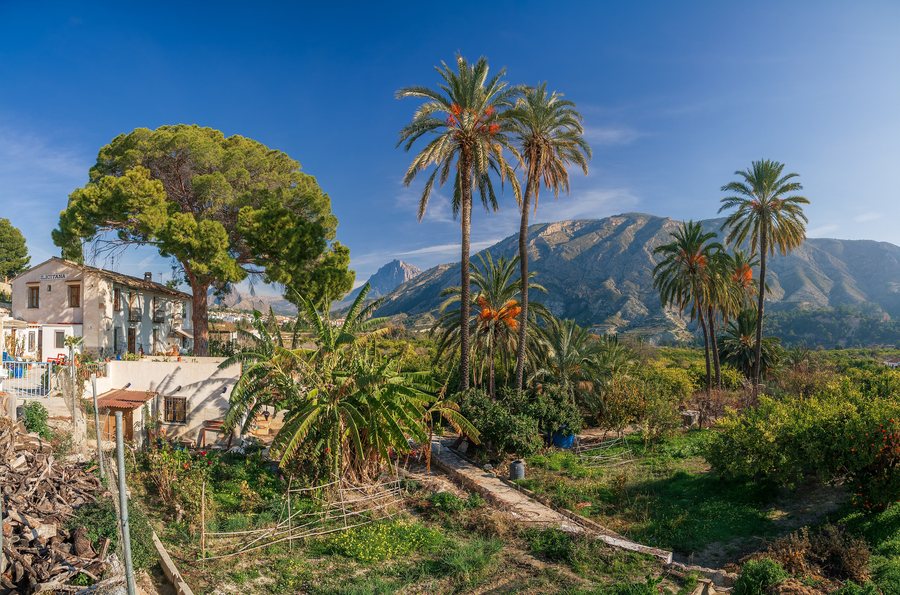 File:Garden landscape in Orxeta, Alicante, Valencia, Spain, 2020 January.jpg
Photo: Ximonic (Simo Räsänen) via Wikimedia Commons, CC BY-SA 4.0
File:Garden landscape in Orxeta, Alicante, Valencia, Spain, 2020 January.jpg
Photo: Ximonic (Simo Räsänen) via Wikimedia Commons, CC BY-SA 4.0
Valley, Gorge and Trails
The L'Estret gorge is considered a habitat for large birds of prey and numerous endemic plant species. The Amadorio Reservoir is also one of the scenic places that can be reached from Orxeta by hiking along old drovers' roads. The PR-CV 353 hiking trail can be accessed via the CV-770 road between Villajoyosa and Sella. At the entrance to Orxeta, there is public parking next to Restaurante Paco.
The Rutas Verdes project in Orxeta provides for a network of routes for pedestrians and cyclists, running entirely along traditional paths and drovers' roads.
Rock Art and Historical Traces
Orxeta has two rock shelters with post-Paleolithic paintings. They are provisionally dated to the period between the 4th and 3rd millennia BC and belong to the styles known as schematic and Levantine art, respectively. The post-Paleolithic rock art sites in Orxeta expand the collection of rock art sites in the Mediterranean arc of the Iberian Peninsula, whose art was declared a UNESCO World Heritage Site in 1998.
Historic paths and buildings also shape the village. The historic mule track Camí del Peix passed through eight municipalities: Alcoi, Benifallim, Orxeta, Penàguila, Relleu, Sella, La Torre de les Maçanes and La Vila Joiosa. The Ermita de Santo Tomás was built in 1665 and forms the final landmark of Orxeta's traditional Calvario route. Orxeta's Cruz de Término consists of circular steps, a shaft and a wrought-iron cross.
The Iglesia Parroquial de San Jaime Apóstol was built between 1759 and 1761. It is dedicated to the Apostle James and features a neoclassical floor plan. Together with the Ermita and the Cruz de Término, it offers several concrete points of access to the village's history, without letting nature experiences and hiking trails recede into the background.
Festivals and Gastronomy
The Fiestas Patronales en Honor a Santo Tomás y San Nazario take place every year during the penultimate week of September. They begin on Thursday afternoon and end during the night leading into the following Monday. The program includes, among other things, a Correfoc, a large communal barbecue, masses, processions and the ascent of Santo Tomás to the Ermita.
The various editions of Orxeta's Fira Gastronòmica combine gastronomy with tastings, family activities, hiking excursions, competitions, music and theater.
Discover More Destinations
Mutxamel, Gaianes, La Vall De Laguar, Petrer, Albatera, Muntanya de la Sella, Callosa De Segura and El Bacarot
Alicante: regional travel overview.

