
Chiva De Morella between Trails, Sanctuary and Built Heritage
Accommodation in Chiva De Morella
Chiva De Morella combines trails, buildings and religious tradition. For interested travelers, the highlights are not limited to a single destination: two linear routes lead through different trail settings, while a former hospital, the Santuario de la Virgen del Roser and an abandoned masía provide insights into the history of the village and its surroundings. This picture is complemented by a small fountain on the old connecting path to Morella.
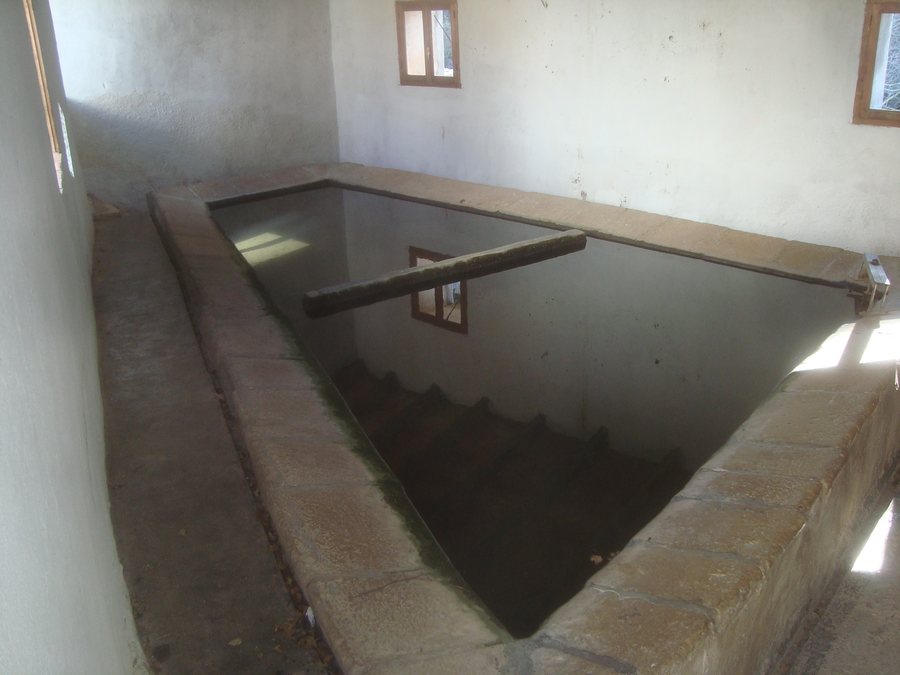 File:Lavadero público de Chiva de Morella.,.jpg
Photo: Juan Emilio Prades Bel via Wikimedia Commons, CC BY-SA 4.0
File:Lavadero público de Chiva de Morella.,.jpg
Photo: Juan Emilio Prades Bel via Wikimedia Commons, CC BY-SA 4.0
Routes with Different Rhythms
The PR-CV 216 is a six-kilometer linear route from Morella to Xiva de Morella; the estimated walking time is two hours. It leads through a small pine forest to Xiva and reaches the Ermita del Roser at the source of the Xiva River.
The PR-CV 217 is also linear and covers 13 kilometers, running from Xiva de Morella to Forcall. It leaves Xiva via the village’s main road and then continues onto a forest track. Along the way, it crosses the Río Bergantes via a large wooden bridge and passes through an old mill. The two linear routes lead in different directions: the PR-CV 216 connects Morella and Xiva de Morella over six kilometers, while the PR-CV 217 runs from Xiva de Morella to Forcall over 13 kilometers.
Local History and Religious Buildings
House No. 24 stands on Calle Mayor. It was the former hospital of Xiva. At the entrance, there is a round arch with a plaque above it dated 1551.
The original Ermita del Roser was built in 1242. The present-day Ermita and the Calvary were built between 1890 and 1895; the ensemble is designated as a Site of Local Relevance. The Santuario de la Virgen del Roser comprises the Ermita, the hermit’s house, the Calvary and the Capelleta vella de la Virgen del Roser.
The Virgen del Roser is the patron saint of Xiva. Its festival takes place on the second weekend of August. Every five years, the Quinquenni is celebrated, during which the image is carried from the Ermita to Xiva.
Mas de Mejora preserves the typical layout of a traditional masía, with a dwelling, livestock stalls and a hayloft. The construction consists of dry stone masonry and rammed earth. Among the surviving elements are the original wooden balcony, the double-leaf entrance door and wooden livestock fences. The masía was abandoned in the 20th century.
Trails, Water and Dry Stone Walls
A small covered fountain stands beside the old path that connected Xiva with Morella. It has access steps and a side wall to prevent earth from sliding down; all elements are built using traditional dry stone masonry techniques. This structure complements the routes and historic buildings with another specific detail of the rural trail network.
Other places: Ortells.
For the broader travel overview: Morella.

