
Murla among castle traces, churches and paths through the landscape
Accommodation in Murla
Murla combines traces of history with paths through a varied landscape. The parish church, former castles, hermitages, viewpoints and routes along the riverbed give the town several facets that you can discover according to your travel interests. When choosing a hotel or other accommodation, this combination helps you plan your stay around culture, short visits to local sights and excursions into the surrounding area.
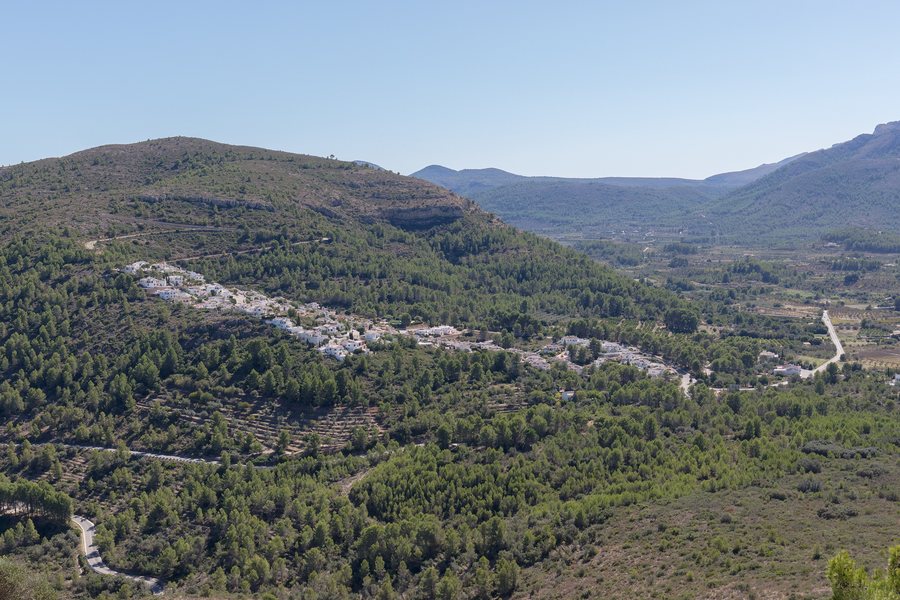 File:Puerta del Valle, Murla, provincia de Alicante, España, 2022-10-02, DD 05.jpg
Photo: Diego Delso via Wikimedia Commons, CC BY-SA 4.0
File:Puerta del Valle, Murla, provincia de Alicante, España, 2022-10-02, DD 05.jpg
Photo: Diego Delso via Wikimedia Commons, CC BY-SA 4.0
Castles and churches with a history of their own
Murla developed from a medieval alquería around Pop Castle. Today, this is identified with the town’s parish church. Another historical reference is El Castellet, also known as Castell de Murla, on Puig d’Orba; only a few crumbling walls remain, overlooking La Rectoría, a subcomarca within the broader Marquesado de Denia.
El Castellet is easily accessible from the Vellich and Comeig areas via an old bridle path. In the town itself stands the Ermita de la Divina Aurora, also known as Ermita de la Sang, in the town centre. Its site formerly belonged to a hospital, more precisely to its women’s ward, and was later also used as a prison. Thus, religious architecture and different historical uses come together at this site.
The fortified church of Sant Miquel Arcàngel is particularly characteristic. It is located in a former castle from the Islamic period and has been designated a Bien de Interés Cultural, a status declared on 14 August 2001. Its defensive function was reinforced in the 16th century by attacks from Barbarossa’s pirates. The church can therefore be viewed not only as a religious building, but also in connection with Murla’s former fortification history.
Paths, viewpoints and Mediterranean landscape
The PR-CV 426 Penyó Roig route begins in Murla and leads via the Calvario de Murla to the Ermita de Sant Sebastià. It is situated in a typically Mediterranean setting with abundant pine trees and scrubland. Nearby, there is a viewpoint equipped with benches and offering wide-ranging views. From the summit of Penyó Roig, the views extend over the Xaló River, Seguili, Montgó, Segària, Carrascar and the sea.
The Camins de pedra i aigua route also connects to Murla and continues towards Benigembla. On this section, it follows the riverbed and offers an experience of nature and wildlife. Murla is also associated with the LIC Conca del riu Gorgos, which is one of the places of interest for Murla. These paths and landscape connections offer a different perspective on the town from its historic buildings.
The Ermita de Sant Sebastià can be reached on foot via a path or by vehicle via a track. The track begins at the road connecting Murla with Fleix and Campell in La Vall de Laguar.
Nearby places for comparison
If you would like to explore destinations near Murla as well, you can find La Vila Joiosa, Polop, Villena, Jijona, Sanet Y Negrals, Las Virtudes, San Juan De Alicante and Calpe here.
A small detail shaped by history adds to the townscape: El Rajolat is a stone bench made of slabs, associated with the historic emigration from Murla and still serving today as a shady meeting place. Together with the Font i llavador Nou de Murla, located beside the spring, this site points to earlier forms of community life. The Font i llavador Nou was formerly a meeting place and a leisure area for women.
For the higher-level travel overview: Alicante.

