
Penàguila: Medieval Heritage, Garden and Trails
Accommodation in Penàguila
Penàguila combines a medieval townscape with the Jardín de Santos, ravines and regional cuisine.
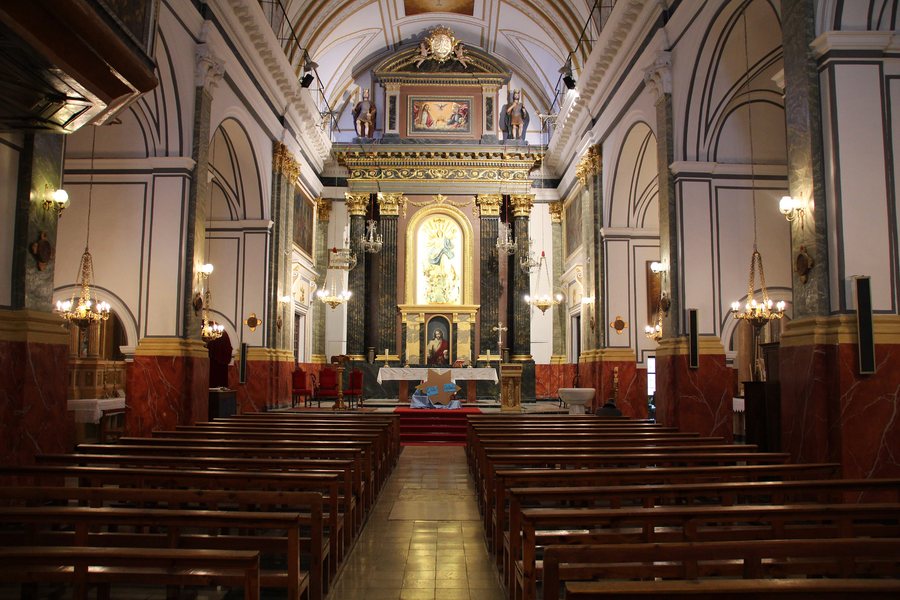 File:Esglèsia de l'Assumpció de Penàguila.jpg
Photo: DIÀNIA TELEVISIÓ via Wikimedia Commons, CC BY-SA 4.0
File:Esglèsia de l'Assumpció de Penàguila.jpg
Photo: DIÀNIA TELEVISIÓ via Wikimedia Commons, CC BY-SA 4.0
The medieval quarter of Penàguila
The medieval quarter of Penàguila was established at the end of the 13th and beginning of the 14th century following the carta puebla granted in 1278 by King Peter III of Aragon. Its rectangular layout reflects the military architecture of the period. The entire perimeter was enclosed by a wall, the remains of which are still visible.
The Portalet is a well-preserved gateway to the medieval quarter. The quarter was laid out at right angles for reasons of security and control. The Torre Vernet is the quarter’s only freestanding tower. It is partially preserved and was recently consolidated and restored; a preserved section of wall can be seen beside it.
Gardens and trails through the landscape
The Jardín de Santos was created in 1841 by Joaquín Rico y Soler. Large trees surround the garden, which includes a three-storey Neoclassical pavilion, a large rectangular pond, a woodland, an aviary, statues, a viewpoint, a grotto and a hedge maze. The garden therefore offers several different settings for a stay combining architecture, landscaped nature and quieter paths.
The phytoclimatic route at the Barranco de Aladrach begins at the cypress avenue directly at the exit of Penàguila and leads through the shady side of the ravine. The Abric del Port de Penàguila is one of seven local rock shelters. It is one of the two shelters with gates that are considered more accessible, depending on the state of maintenance of the paths.
The two circular routes differ mainly in length and difficulty. The approximately 7 km route via Arco de Santa Lucía and Castillo de Penáguila is classified as moderate to challenging. The approximately 28 km route via Font de L'Arbre, by contrast, has a moderate difficulty level.
The short, vertical Barranco del Salt de Penàguila, with a height of approximately 70 metres, is also located near Penàguila. It is descended in four rappelling sections.
Culture, tradition and regional cuisine
The Castillo de Penàguila is classified as an Asset of Cultural Interest (BIC) and is considered a building from the Almohad period of the 12th century. South of Penàguila, the Ermita de los Santos Médicos Cosme y Damián stands on the mountainside. It belongs to Valencian Gothic architecture and is considered a so-called Reconquista hermitage dating from the 13th to the 15th century.
The traditional process of olive oil production is the focus of the Museo Etnológico de Penàguila. Historical equipment such as millstones, presses, a stirrer, esparto baskets and settling basins can be seen. The Feria de Santa Lucia complements this cultural offering as a two-day fair for visitors, featuring local and craft products, traditional dances, dulzaina music and performances by the Sociedad Musical Cultural de Penàguila.
A special time-based observation is offered by the solar alignment at the Arco de Santa Llúcia: between 13 and 29 December, the solar disk passes through the arch for approximately five minutes. Penàguila’s traditional cuisine includes Pericana, Arroz con conejo, Pebreretes Farçides, Olleta and Borreta.
Discover more places:Agost, Benejúzar, Ontilles, Alfafara, Elda, El Fondó De Les Neus, Daya Nueva and Los Arenales Del Sol.
For the higher-level travel overview: Alicante.

