
Llosa de Ranes between the hilltop village, Santa Anna and the Cànyoles Plain
Accommodation in Llosa De Ranes
Llosa de Ranes brings together, within a small area, a town centre on a hill and a landscape where steep, mountainous terrain meets irrigated farmland in the floodplain of the Cànyoles River. This contrast shapes the way you can discover the town. Around Santa Anna, natural surroundings, panoramic views and an annual tradition come together.
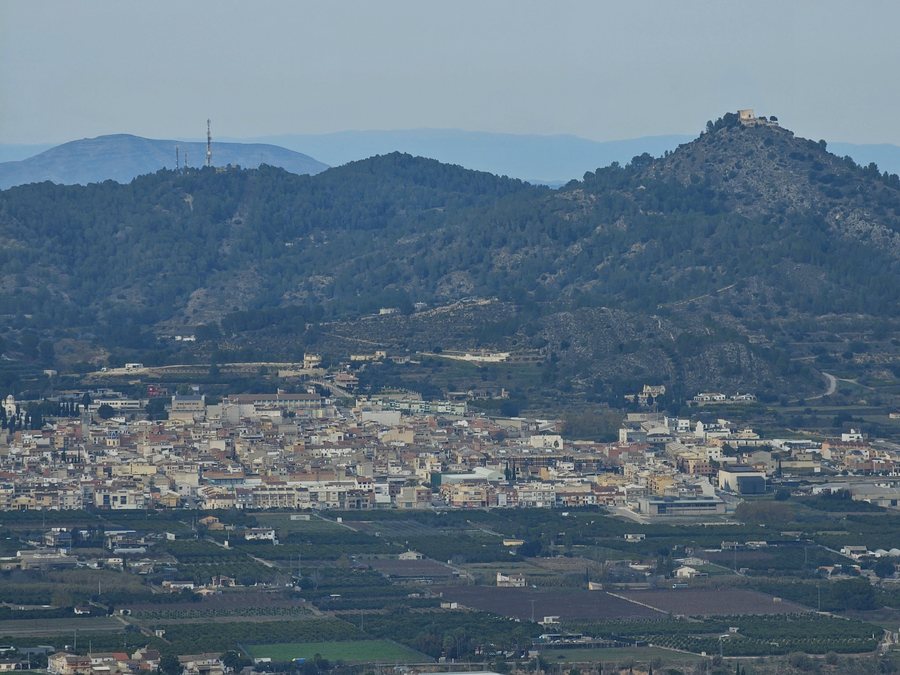 File:Vistas de la Llosa de Ranes desde el Castell de Xàtiva.jpg
Photo: Khan.gesta via Wikimedia Commons, CC BY-SA 4.0
File:Vistas de la Llosa de Ranes desde el Castell de Xàtiva.jpg
Photo: Khan.gesta via Wikimedia Commons, CC BY-SA 4.0
Churches, chapels and features in the townscape
The Iglesia Parroquial de la Natividad de Nuestra Señora is a church building dating from the 19th century. A smaller, very specific trace of popular religious devotion can be found on Calle Doctor Cajal: there is a ceramic street altarpiece dedicated to San Jaime, dating from the 18th century. Both examples show different scales—here the church building, there an altarpiece integrated into the street space.
The Fuente de la Iglesia is a preserved public spring built in 1786.
The Ermita del Cristo del Milagro is a chapel built in the 18th century in the countryside. The Ermita de Santa Anna is located in the area of Llosa de Ranes but belongs to the municipality of Xàtiva. This municipal affiliation is particularly important for orientation: the geographical connection to Llosa de Ranes and the municipal affiliation with Xàtiva are two different details that coexist.
Santa Anna: views, route and Romería
The Romería a Santa Anna takes place every year on 1 May. During it, the image of the saint is transported in a horse-drawn carriage. This makes the date a clearly defined part of the annual calendar and gives your travel planning a specific cultural anchor if you are interested in religious traditions and local customs.
Santa Anna is also associated with expansive views across the landscape. On clear days, the views from the Santa Anna hilltop extend from the Desert de les Palmes to Benicadell. The viewpoint therefore does not stand in isolation alongside the town's sights, but complements the impression created by the municipal area’s transition between mountain terrain and irrigated plain. An asphalted, signposted route leads from the town to the Baños de Santa Anna.
The Baños de Santa Anna used to be a thermal spa and are now a recreational area. Their present function therefore explicitly differs from their former use. Together with the asphalted, signposted route, this creates a distinct excursion focus within Llosa de Ranes: you can view the former thermal spa site as a recreational area and observe the connection between settlement, route and landscape without considering it a thermal spa that is still in operation.
Local history and flavour
The Casa del Pou Museum is located in a former bourgeois house that once housed the town hall and was converted into a museum in 1979. The museum presents the most important sociocultural milestones of Llosa de Ranes through the life and social cycle of the town. This gives the local history a specific address and connects the former town hall with the social development of Llosa de Ranes.
The local character also includes Formatge blanquet, which is also called queso servilleta. It is made artisanally in Llosa de Ranes from fresh goat's milk. If you would like to combine cultural visits, landscapes and regional cuisine when choosing a hotel or other accommodation, this combination offers several distinct points of interest: the hilltop centre, the chapels and religious traditions, the Santa Anna landscape, the museum and a local speciality.
More places to discover
If you would like to explore other places from the same selection in addition to Llosa de Ranes, you can then visit La Barraca d'Aigües Vives, Chella, Vallés, Navarrés, Llutxent, Campo Olivar, Guadasequies and Bétera.
For the overarching travel overview: Valencia.

