
Discover Benilloba: Waterfall Route, Church Art and Living Traditions
Accommodation in Benilloba
Between River, Waterfall and Local History
Benilloba lies on the Frainós River. The approximately 6.5 km-long El Salt de Benilloba route begins in Benilloba, follows the Senda Dels Molins and reaches the Molí del Salt, which is also called Fábrica de la Llum. At this point, a small waterfall forms in the Frainos River, known as Salt de Benilloba.
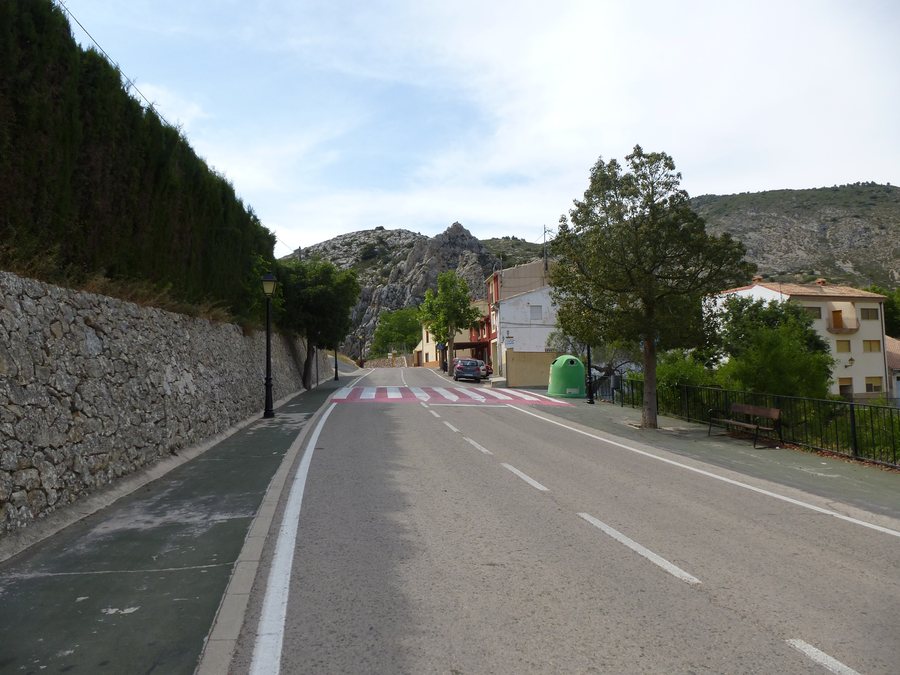 File:03810 Benilloba, Alicante, Spain - panoramio.jpg
Photo: chisloup via Wikimedia Commons, CC BY 3.0
File:03810 Benilloba, Alicante, Spain - panoramio.jpg
Photo: chisloup via Wikimedia Commons, CC BY 3.0
The descent to the Molí del Salt has a masonry staircase and is therefore accessible to everyone. The Molí del Salt is freely accessible and can be visited at any time. The Molí del Salt was built in the decade from 1760 to 1770. At the Molí del Salt, the historic building and the watercourse meet directly.
Paths with Views and Architectural History
The walking path to Cerro del Calvario includes a grove of centuries-old cypress trees and offers panoramic views of Benilloba and the comarca.
At the municipal boundary between Benilloba and Penáguila, near the Molí harinero de Raimundo, which is located in the municipality of Penáguila, stands the two-arched La Canal aqueduct. One arch is small, while the other is large and curved. Built in 1794, the structure carried the acequia d’Ombria across the ravine to irrigate Benilloba’s orchards.
Church, Tower and Ceramic Street Altarpieces
The Iglesia Parroquial de Benilloba is a Neoclassical church. Its floor plan follows a Latin cross; the three-bay nave is accompanied by side chapels. In the deep presbytery, the barrel vault is decorated with rosettes and frescoes. They depict four biblical heroines and Saint Juan de Ribera.
The Torre Árabe de Benilloba is also part of the historic character of the town centre. Today, it is the bell tower of the parish church; at the same time, it corresponds to the minaret tower of the former mosque. Ceramic street altarpieces in the historic town centre usually depict the saint to whom the respective street is dedicated.
The Señorío de Benilloba came into the possession of the aristocratic Revillagigedo family in 1757.
Festivals and Regional Cuisine
The traditional dances in honour of the Virgin Mary take place on the first weekend of September. From Thursday to Sunday, the “Dansà de Benilloba” is danced in traditional dress in the Plaza del Omet; anyone who would like to take part can join in. The festivals in honour of Sant Xotxim are represented by the three filaes “Moros del Castillo”, “Filà Cristianos de La Palmera” and “Moros del Arrabal”. The Moors and Christians tradition takes place every year in August and includes the humorous Nit de l’Olla.
The traditional Good Friday market in Benilloba features demonstrations and the sale of regional products: cured meats, traditional dishes, cheese, wine, olive oil and the traditional Mona de Pascua.
Discover More Places
San Isidro, Barbarroja, Daya Nueva, Benifato, Xinorlet, Parcent, L'Alguenya and San Fulgencio
For the overarching travel overview: Alicante.

