
Ares del Maestre: Castle, Rock Art and High Plateau
Accommodation in Ares Del Maestre
Ares del Maestre combines historic buildings, religious sites, medieval fortress remains and striking landforms. This creates a destination that can be explored through several themes: from the Gothic townscape and the history of the castle to the high plateau and rock art. Those wishing to combine culture and nature will find various starting points here for planning their own trip.
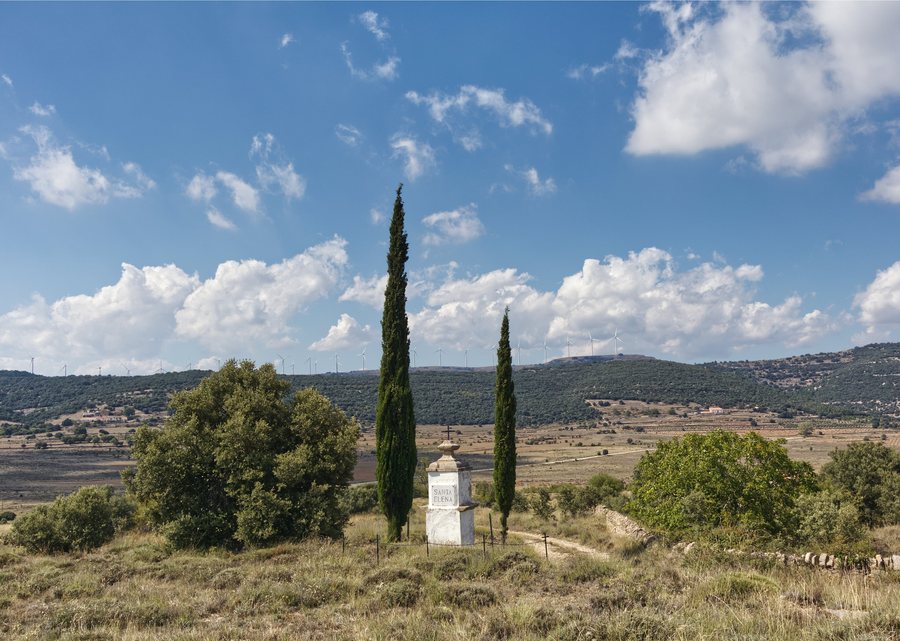 File:Capillita de Santa Elena - Ares del Maestre - 01.jpg
Photo: JavierMunozF via Wikimedia Commons, CC BY 4.0
File:Capillita de Santa Elena - Ares del Maestre - 01.jpg
Photo: JavierMunozF via Wikimedia Commons, CC BY 4.0
Historical traces in the townscape
Around Plaça Major, the historic centre includes a former prison and an old market hall. Both buildings date from the 13th century and were built in the Gothic style. The Parish Church of the Assumption of Our Lady is an 18th-century Baroque church. Its smaller bell tower is the surviving part of an earlier Gothic church. The buildings therefore reveal different historical layers without losing their individual characteristics.
Castle and mills in the hinterland
The remains of Ares del Maestrat Castle stand on a rocky plateau at the highest point of the town. The medieval fortress was built over the remains of an earlier Roman structure. Barranc dels Molins also preserves an 18th-century hydraulic engineering complex with five mills for producing flour. The castle and mills thus offer two different ways of approaching the history of the town: on the one hand, successive fortifications, and on the other, the technical use of water.
Snow, storage and remembrance
Nevera de los Regatxols was built in the 17th century as a snow store. After its restoration in 2005, it became an interpretation centre. It includes an eight-metre-deep snow shaft that visitors can explore. Visits to the Museo de la Nevera de la Font dels Regatxols must be arranged by telephone.
Landscape and rock art
The La Mola d'Ares Municipal Natural Area is a plateau 1,321 metres high, formed by differential erosion and bordered by steep cliffs. Ares del Maestre lies on a rocky hill and overlooks the rugged landscape of El Maestrazgo. Cova Remígia contains more than 750 figures depicting a wide range of themes in Levantine rock art. Seven different phases of use have been dated for the rock shelter.
Santa Elena and a fixed pilgrimage date
The Ermita de Santa Elena is an 18th-century chapel of the rural Baroque style with a painted interior. The pilgrimage to it has taken place every year since 1742, on the first Sunday in May. The chapel is located at the masía of the same name, 5 km from the municipality. From Ares del Maestrat, it can be reached via the CV-15 road towards Vilafranca and then along a track.
The individual sites offer different starting points for your planning. In the historic centre, the focus is on architectural forms and local history; at the castle, on the connection between the medieval and Roman past; while Barranc dels Molins and Nevera de los Regatxols illustrate earlier technical solutions. La Mola d'Ares and Cova Remígia add geology and rock art to this perspective. This allows you to bring culture, landscape and regional history together in one travel plan without turning them into a single experience.
More destinations
More destinations: Moncófar, Nules, Benicarló, Lucena Del Cid, Cinctorres, Vilanova D'Alcolea, Castellfort, Cervera Del Maestre.
For the higher-level travel overview: Castellon.

