
Castellfort between Pilgrimage Sites and Hiking Trails
Accommodation in Castellfort
Castellfort combines notable evidence of religious and rural history with paths through a landscape shaped by dry-stone structures. Those planning a trip to Castellfort and weighing up culture, pilgrimages, regional festivals and hiking will find a range of possibilities here—from the town center to the paths leading to Sant Pere, Portell, Vilafranca and Cinctorres.
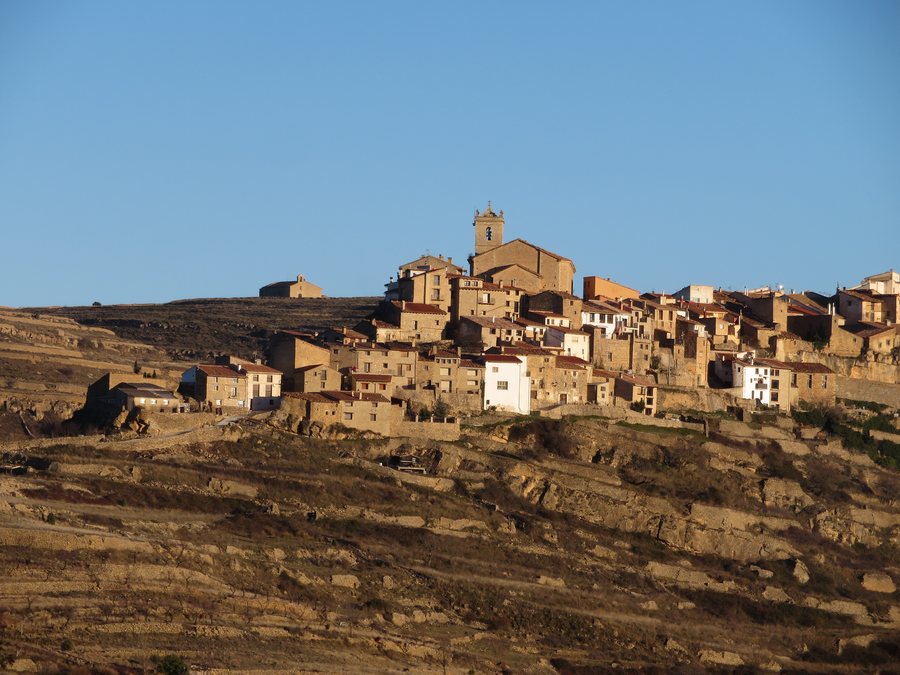 File:Municipio de Castellfort, provincia de Castellón (España). 2026.jpg
Photo: Juan Emilio Prades Bel via Wikimedia Commons, CC BY 4.0
File:Municipio de Castellfort, provincia de Castellón (España). 2026.jpg
Photo: Juan Emilio Prades Bel via Wikimedia Commons, CC BY 4.0
Churches, Chapels and Historic Sites
The coat of arms of the Monserrat family, the Marqueses de Castellfort, is located on the entrance door of the Casa de los Marqueses de Castellfort. In the Sala Pintada, Castellfort preserves valuable black-and-white murals depicting scenes from the life of Jesus and the Virgin Mary. The parish church was inaugurated in 1734 after eight years of construction and later received bells, an organ and altarpieces. The town’s religious features also include the Capillitas: niches with religious ceramic panels dating from the 18th century to the present day.
The Cofradía dels Lletrats also dates back a long way. It was founded by King Jaume I and can be dated to the mid-16th century. The porches of Castellfort date from the 17th and 18th centuries. The Sant Pere hermitage is a large, recently restored church featuring transitional forms between Romanesque and Gothic architecture from the 12th and 13th centuries. The Mare de Déu de la Font pilgrimage complex comprises a church, a guesthouse, stables and the Sala Pintada, which are grouped around a formerly enclosed square. In 1979, proceedings were initiated to classify the Mare de Déu de la Font hermitage as a Bien de Interés Cultural.
Archaeology and Landscape
La Lloma Comuna is a fortified settlement from the Early Iron Age, dating approximately to the 7th century BC; it covers a total area of 6,000 m². In 2021, the first excavation area there was converted into a museum site. Information panels and a visitor-friendly circular route make the archaeological site accessible as a separate point of interest.
The Rambla Celumbres natural area is considered worthy of protection because of its ecological, scenic, historical-cultural and recreational values. A bridge stands by the rambla which, based on its construction, workmanship and location, is probably a preserved Roman bridge. Another bridge lies along the historic route from Castellfort to Portell. The dry-stone heritage is particularly visible around Sant Pere and along the route to Vilafranca. The PR-CV-309 hiking trail passes through an area with numerous dry-stone structures that has been declared a Bien de Interés Cultural, and connects Castellfort with Vilafranca.
Festivals and Pilgrimage Traditions
Castellfort’s San Antonio festival, held in January, combines religious ceremony and local tradition: after the animals are blessed, traditional pastries are distributed with aguardiente and moscatel; the festival ends with the burning of a large barraca. During the Fiesta del Raimet, the exclusively male Cofrades gather in the Cofradía to eat blessed bread and blessed grapes.
The Sant Pere hermitage is the destination of numerous pilgrimages, including those of the dels Catinencs and pilgrims from Portell. The Els Catinencs pilgrimage reaches Sant Pere de Castellfort on the first Saturday in May. In Castellfort, fixed festival dates and historically established routes thus complement one another, creating a destination whose character is strongly shaped by religious sites and traditional customs.
Hiking Trails Around Castellfort
The PR-CV-64 circular hiking trail to Sant Pere starts and ends in Castellfort. The PR-CV-332 connects Castellfort and Portell and follows the old pilgrimage route from Portell for much of its length. The PR-CV-308 hiking trail runs from Castellfort to the municipality of Cinctorres.
For further regional orientation, you can also keep Les Alqueries, Fredes, Xilxes, Cabanes, Sant Joan de Moró, Caudiel, Montán and Bell-lloc in mind.
For the higher-level travel overview: Castellon.

._2026.jpg)