
Macastre between the Castle, Springs and Wine Tradition
Accommodation in Macastre
Macastre combines historic traces, marked trails, springs and a strong wine tradition.
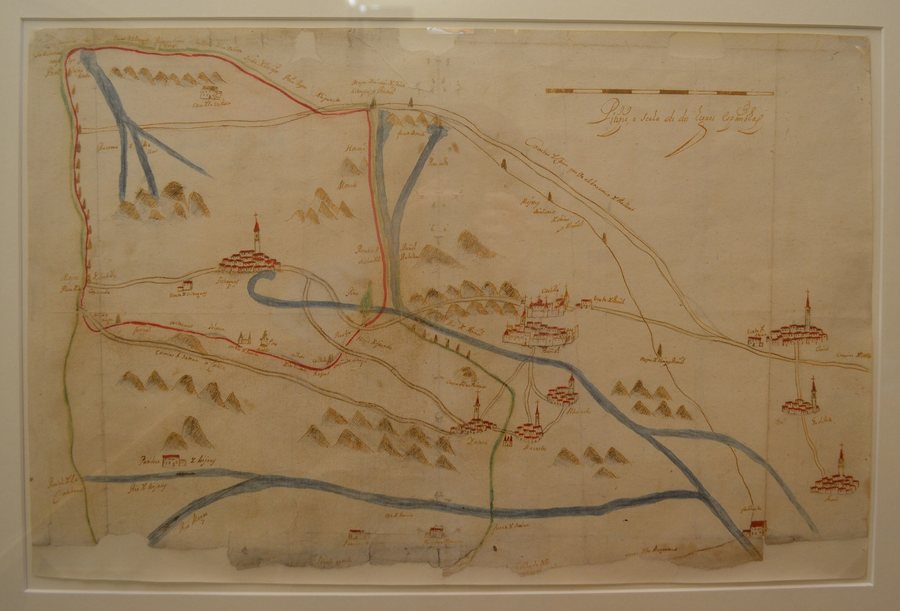 File:Mapa de 1721 de los términos de Siete Aguas, Buñol, Chiva y Macastre - Archivo Reino de Valencia.jpg
Photo: Dorieo via Source, CC BY-SA 3.0
File:Mapa de 1721 de los términos de Siete Aguas, Buñol, Chiva y Macastre - Archivo Reino de Valencia.jpg
Photo: Dorieo via Source, CC BY-SA 3.0
Old Town, Church and Castle
A walk through the Old Town leads to Plaza de los Árboles and the surrounding houses. Some of these buildings date from the 19th century, including the present-day town hall. Another historical highlight is the parish church of the Transfiguration of the Savior, which was built between the 17th and 18th centuries.
The Castillo de Macastre is a fortress of Islamic origin. It stands on a site that was previously occupied by a Bronze Age settlement. The remains of the main tower, cistern and surrounding fortifications can be seen at the site; these remains are accessible via an easy route. The Mirador de los Vientos is also a viewpoint and a worthwhile destination that you can reach on a walk through Macastre.
Trails, Springs and the Magro River
For longer hikes, the PR-CV 191 Macastre is the main route. The trail is 24.00 km long and has a theoretical walking time of six hours, with 935 m of ascent and descent respectively. No quality checks are available for its certification. In addition, Macastre has a network of marked trails connecting places of scenic interest.
You can reach the Fuente de Santa Bárbara via Eduard Escalante Street to the Las Eras neighborhood, and then through a downhill lane at the end of which the spring is located. The Fuente Grande is a natural spring whose fresh water flows to the outlets. Densely grouped trees provide shade and coolness there; there are also paella grills and picnic tables. The Magro River crosses the entire municipality of Macastre along a deeply incised course and forms gorges.
Festivals, Cuisine and Winegrowing
The annual events calendar offers cultural occasions of its own. The local festivities take place in the first half of August in honor of the patron saints Santa Bárbara and San Salvador. They include exhibitions, sporting competitions, traditional open-air dances and concerts. On the first weekend of September, the festivities of the “las clavarias de María” follow, with religious celebrations in honor of the Virgin, mascletàs, open-air dances and processions.
Local cuisine includes Mojete with pork liver, oil and flour; Rin-Ran with cod, eggs, garlic, potatoes and raw oil; as well as Gazpacho manchego and Torta boba. This culinary profile is complemented by intensive grape growing and a strong winegrowing tradition. When choosing your accommodation, you can therefore consider whether you mainly want to discover Macastre through its historic sites, hiking trails, springs, festivals or cuisine.
You can find more places for your regional planning here: Canet D'en Berenguer, Villar Del Arzobispo, Montesa, Faura, Alzira, Sueca, Calles and Ayora.
For the higher-level travel overview: Valencia.

