
Ontinyent between La Vila, museums and historic routes
Accommodation in Ontinyent
Ontinyent combines medieval urban history, museums, distinctive routes and a cuisine closely associated with the fair. This creates a destination whose character can be discovered through its buildings, festivals, industrial heritage, public transport connections and regional specialities.
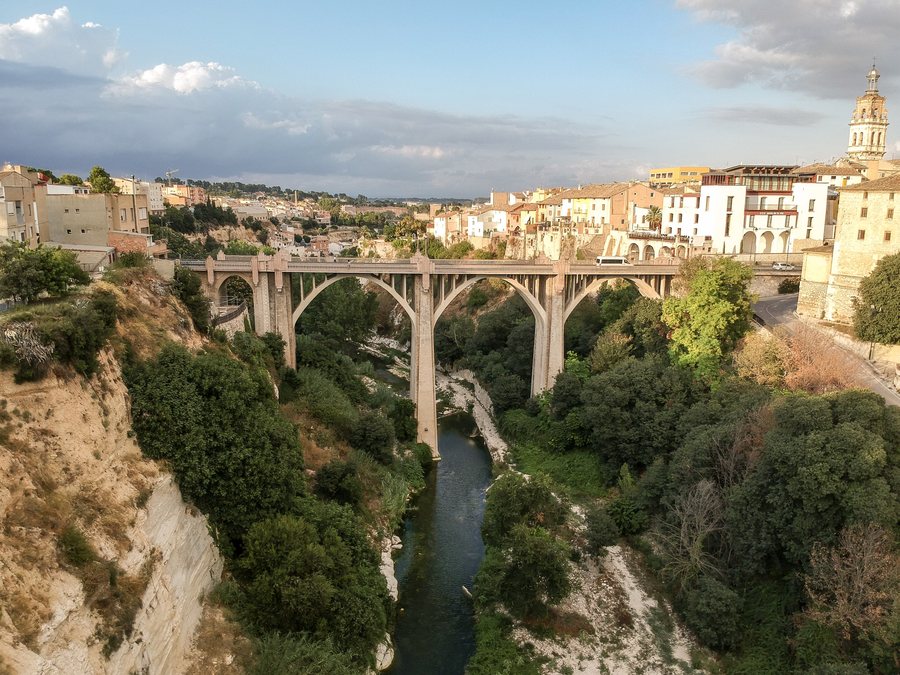
La Vila and the historic town
La Vila is considered the historic origin of Ontinyent. In the 1970s, the district was classified as a historic-artistic ensemble. It preserves one of the most representative medieval ensembles in the Valencian lands – both in quality and quantity.
Among the most prominent buildings is the Church of Santa María. It was probably built between the 14th and 16th centuries on the site of a former Islamic mosque. Inside, a Gothic ribbed vault carried on spiral pilasters supports the architecture; the main portal was created in 1530 in the Renaissance style. The Pont Vell was built in 1500. Its masonry, made of dressed stone blocks, has withstood all the Clariano’s floods over the centuries.
The route through La Vila leads through historic streets and Atzucacs. Along the way, important buildings in the town come into view, as do remains of the old wall and towers hidden between present-day houses, which formed part of the original fortified complex. The Chimneys Route offers a different perspective: it is a walking route to the factory chimneys around the historic centre, less than 3 kilometres long and manageable in about an hour.
Museums, festivals and crafts
The MAOVA, the Museo Arqueológico de Ontinyent y La Vall d’Albaida, is housed in the former Almudí building from the 16th to 17th centuries. In two large exhibition areas, it presents history from the Late Palaeolithic to the modern era.
Those interested in the region’s craft traditions will find a dedicated perspective at the Fundació Museu Textil de la Comunitat Valenciana. The museum is housed in the former Hilados Manuel Revert Nadal spinning mill at Calle Músico Úbeda No. 6. Objects from the 18th century to the present explain the craft processes involved in textile production. The exhibition is divided into four rooms: instruments, production, textiles and an audiovisual room.
The Museu Fester d’Ontinyent displays emblematic pieces relating to the Moors and Christians festival and traces the history of these celebrations. The Moors and Christians festival in Ontinyent is recognised as a festival of international tourist interest.
Routes and planning your stay
The Air-Raid Shelters Route allows you to discover Ontinyent’s history during the Spanish Civil War; it also provides an opportunity to visit the interiors of recently restored air-raid shelters. Fuset has a recreational area equipped with facilities and tables. Signposted routes start and end there, and Fuset also offers four different themed routes.
Ontinyent is served by the València–Xàtiva–Alcoi railway line and by the regular Autobuses La Concepción bus service from Valencia. These connections are relevant when planning travel by public transport. When choosing a hotel in Ontinyent, you can tailor the focus of your stay to La Vila, the museums, the historic routes, Fuset or the local festival cuisine.
Discover more places
Find more destination ideas at Castielfabib, Cheste, Aielo de Malferit, Benisanó, Mareny de Barraquetes, Caudete De Las Fuentes, Llíria and Turís.
For the broader travel overview: Valencia.

