
Callosa de Segura between the Sierra, history and living traditions
Accommodation in Callosa de Segura
Callosa de Segura combines a striking mountain landscape with an unusually rich cultural history. Between the Sierra de Callosa, historic religious buildings, museums, religious pageants and regional cuisine, you will find many different reasons to discover the town at your own pace.
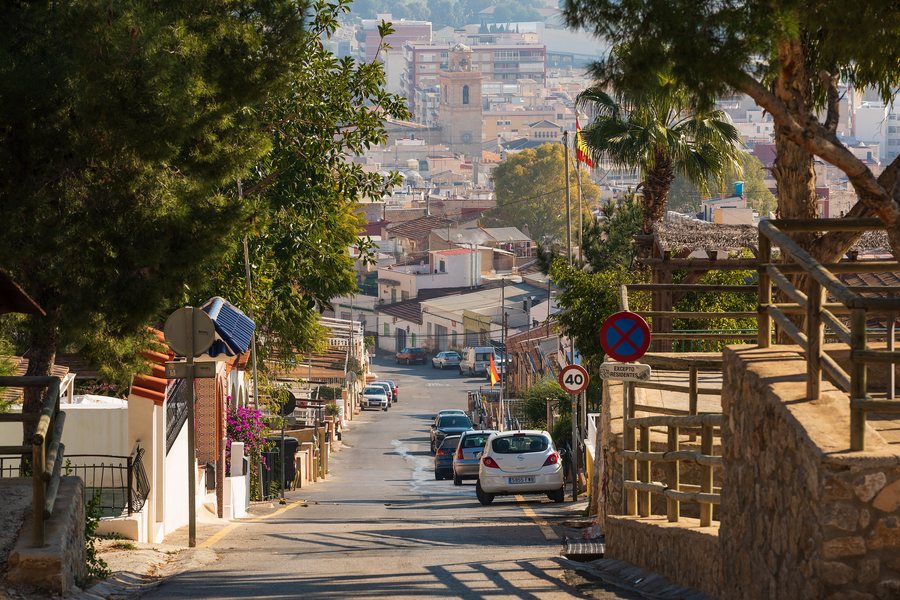 File:Calle Nuestra Señora Del Pilar street in Callosa de Segura, Alicante, Spain, 2022 January - 2.jpg
Photo: Ximonic (Simo Räsänen) via Source, CC BY-SA 4.0
File:Calle Nuestra Señora Del Pilar street in Callosa de Segura, Alicante, Spain, 2022 January - 2.jpg
Photo: Ximonic (Simo Räsänen) via Source, CC BY-SA 4.0
Nature Park and Via Ferrata
The Sierra de Callosa is protected as a municipal nature park and covers just under 150 hectares. The rugged limestone massif rises from an alluvial plain. The nature park includes the La Pilarica and La Cueva Ahumada recreational areas, with car parks, toilets, picnic areas, springs, tables, children's play areas, educational trails and areas adapted for accessibility.
The Vía Ferrata de Callosa de Segura is located on the southeastern side of the Sierra de Callosa, within the municipality of Callosa de Segura. It is free to use and opened to the public in February 2020. The marked access path from the car park at the La Cueva Ahumada nature park reaches the family section in approximately 15 minutes; the signposted sections of the route are clearly marked. The first section has a K3 difficulty rating and is designed as an introductory or family section.
Castle Ruins, Churches and Museums
The ruins of the Castillo de Callosa stand on the Sierra de Callosa, on a rocky summit approximately 200 metres high. They date from the Caliphate period, specifically from the year 961. Because of this origin, the Castillo de Callosa is considered the oldest castle in the province of Alicante. The Santuario de San Roque stands on a 50-metre-high hill; from there, you can take in the panorama known as the “Balcón de la Vega Baja”.
The Iglesia Arciprestal de San Martín was completed in its main construction work in 1553 and combines Gothic, Renaissance, Baroque and Neoclassical styles. Royal Decree 2865/1980 of 14 November declared it a National Historic-Artistic Monument. The Museo Arqueológico Antonio Ballester y Ruiz presents the history of Callosa de Segura from prehistoric times to the present and was founded in 1980. Its particularly significant prehistoric heritage includes the El Argar culture from the Bronze Age, dating from 1,800 to 1,200 BC, as well as the “Laderas del Castillo” archaeological site.
The Museo del Cáñamo Roque Fco Albert Lucas presents demonstrations of the traditional processing of hemp. The museum shows the complete cycle, from sowing and cultivation through to processing into yarn, ropes, nets and espadrilles. Hemp cultivation and the use of its fibres have been a tradition in Callosa de Segura for more than eight centuries and are recognised as intangible cultural heritage of cultural interest.
Holy Week and Festivals
The Museo de Semana Santa José Noguera Valverde displays 25 procession floats belonging to 17 local brotherhoods. An upper walkway provides a view of the floats from above. The processions and religious events of Holy Week are organised by 15 local brotherhoods and religious communities. The living Stations of the Cross on Good Friday begins at the Capilla de San Francisco, follows Calle Vía Crucis to Calvario and includes a dramatised reading of the Holy Gospel.
“La Pasión” is a religious auto sacramental whose modern form was performed in 1969 by the local amateur theatre group Agrupación Artística. Since 1969, the work has been associated with annual performances during Holy Week; in 1982, it received the distinction of an event of tourist interest. “Porta Celi: La Puerta del Cielo” has been associated with annual performances in November since 2011, consists of seven scenes and is performed by more than 50 actors from the patronage organisation. The patronal festivals in honour of San Roque take place every year between 5 and 16 August. The Moors and Christians festivals began in 1977 and include parades featuring Moorish and Christian groups in medieval-inspired clothing.
Getting There and Regional Cuisine
Callosa de Segura can be reached via the A-7, exit 79, followed by the CV-900. From the town, signposted routes continue to the La Pilarica and La Cueva Ahumada recreational areas. The railway station offers daily Cercanías connections to Alicante and Murcia. Traditional dishes from Callosa de Segura include Arroz con costra, Bacalao meneao, Cocido con pelotas and Almojábanas.
Discover More Destinations
If you would like to extend your travel plans beyond Callosa de Segura, also discover Guadalest, L'Atzúbia, Benissili, Benijófar, Busot, Pego, Torrevieja and San Isidro.
Back to the main travel overview: Alicante.

