
Sella: Waterways, Mountain Landscape and History
Accommodation in Sella
Sella lies on the southern slope of the Sierra Aitana at the foot of Penya de Sella. The valley near Sella was shaped by the Sella and Amadorio rivers. On the slopes around Sella are terraced orchards fed by numerous springs and bordered by dry-stone walls. At the Salt weir, the Arc and Sella rivers meet. This gives the town waterways, rock and cultivated slopes, offering different themes for nature, activity and culture.
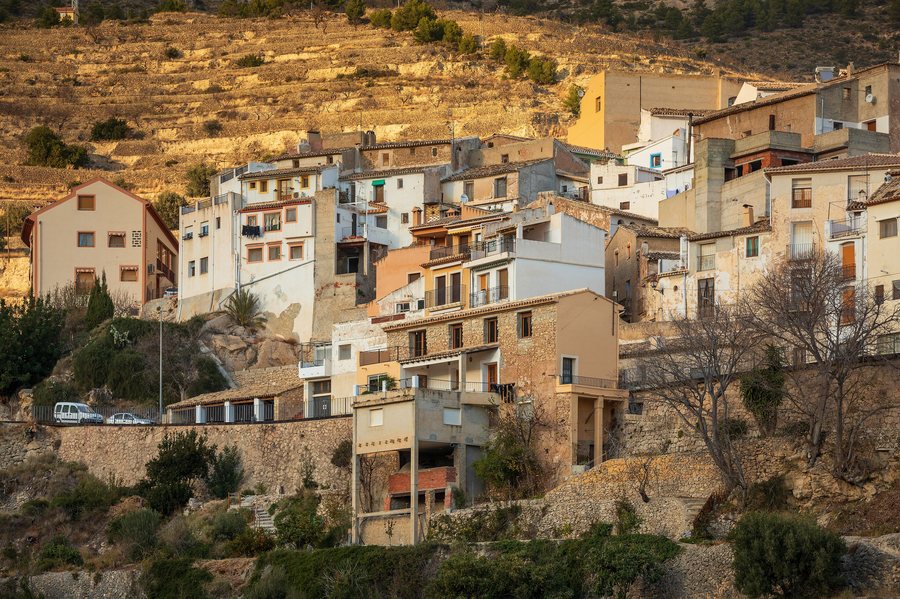 File:Hillside residential of Sella, la Marina Baixa, Alicante, Spain, 2024 January.jpg
Photo: Ximonic (Simo Räsänen) via Wikimedia Commons, CC BY-SA 4.0
File:Hillside residential of Sella, la Marina Baixa, Alicante, Spain, 2024 January.jpg
Photo: Ximonic (Simo Räsänen) via Wikimedia Commons, CC BY-SA 4.0
Waterways and Gorges
The Ruta de l’Aigua (SL-CV 112) is an easy 6.3 km circular trail with an approximate walking time of 2 hours and 45 minutes. It runs from springs through Sella’s historic irrigation system with canals and basins, between terraced orchards, to the historic centre and Plaça Major. Sella also has hiking trails along the gorges of l’Arc and Xarquer-Castellets. The Font Major recreation area was closed until further notice; camping there was prohibited.
Historical Traces in Sella
Castell de Sella is a castle of Almohad origin; a section of the rammed-earth wall from the 12th century has been preserved. The complex comprising Castell de Sella and Ermita de Santa Bàrbara is classified as a BIC and associated with a BRL. Torre i Palau de la Baronía was built from 1507 by the Barons of Agres and Sella. The tower was constructed between 1530 and 1563, has a Gothic portal and was used as a prison on the ground floor. Jaume Congost was the master builder of the church of Santa Anna in Sella and worked in the first half of the 18th century.
La Font also tells the story of the town’s development: Until the road was built in 1920, it was the main access route to Sella’s town centre. As early as the beginning of the 17th century, it was home to the town’s only spring for the human water supply. The rock paintings at Font de l’Arc are between 4,000 and 6,000 years old. Les Voltes was part of the historic trade route Camí del Peix through Sella; it had stables and inns for historic through traffic. Historic hydraulic grain mills were also established in Sella to use water power for processing grain and supplying the population.
Festivals, Crafts and Stories
The Festes Patronals en honor a la Divina Aurora take place in Sella in the first week of October and include a procession at dawn accompanied by a Rondalla. The Muestra de Productos y Cultura Mediterránea takes place annually at the beginning of summer and is a fair for handicrafts, gastronomy and folk culture. On 4 December, the Festa de Santa Bárbara is celebrated with fireworks and a pilgrimage to Ermita de Santa Bárbara. The oral tradition includes El tresor del Diví, a legend from Sella about the discovery of a treasure approximately 250 years ago.
Active Experiences
The municipal Les Saleres sports centre has a covered 35 × 9 metre trinquet where several disciplines of Pilota Valenciana can be played. In Sella, Pilota Valenciana competitions can be watched every Sunday. Climbing is possible in Barranc de l’Arc all year round. Paragliding takes place at Alt de Sella in Barranc de Tagarina.
The Right Accommodation Perspective
If you are considering accommodation in Sella, your planning can be guided by the easy circular trail, the gorge paths, the historic buildings or the festival dates. Travellers looking for activity and landscapes will have different priorities from those who want to combine the castle, tower, church and local culture. The verified places and events therefore offer several concrete approaches to shaping your own daily itinerary.
Further Destinations for Your Planning
Beneixama, Benifato, Granja De Rocamora, Pinoso, Sant Vicent Del Raspeig, Santa Pola, La Encina and Tibi.
For the overarching travel overview: Alicante.

