
Tàrbena: Three Valleys, Cultural Heritage and “el parlar salat”
Accommodation in Tàrbena
Between Three Valleys
Tàrbena is a place where a clearly structured landscape combines with distinctive cultural traces. The municipality of Tàrbena covers 31.7 km² and consists of three valleys. Tàrbena lies in a valley with old farmhouses and springs. The landscape is characterised by almond, cherry and olive trees, as well as rosemary, thyme and camomile. For your travel planning, this creates a clear interplay of valley landscapes, rural architecture and characteristic vegetation: Depending on your focus, you can place local history, the landscape and regional tradition at the centre of your trip.
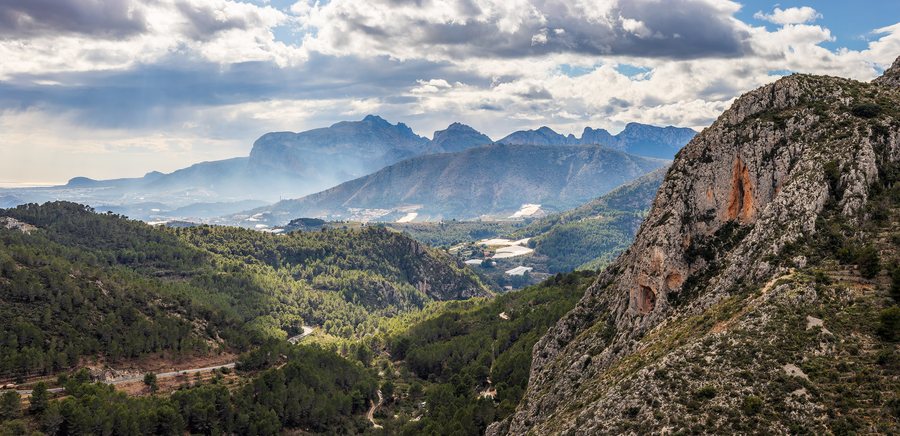 File:Distant landscape towards south from viewpoint by CV-715 in Tàrbena, la Marina Baixa, Alicante, Valencia, Spain, 2025 February.jpg
Photo: Ximonic (Simo Räsänen) via Source, CC BY-SA 4.0
File:Distant landscape towards south from viewpoint by CV-715 in Tàrbena, la Marina Baixa, Alicante, Valencia, Spain, 2025 February.jpg
Photo: Ximonic (Simo Räsänen) via Source, CC BY-SA 4.0
Church, Fortress and Local History
The Iglesia de Santa Bárbara is a Catholic church dedicated to Saint Barbara. Santa Bárbara is the patron saint of the municipality. Construction began in 1721; the church belongs to the Late Baroque period and is classified by the Generalitat Valenciana as a Bien de Relevancia Local.
The Castillo de Tàrbena is also known as Castell dels Moros or Casetes dels Moros. It is a very old fortress and a Mudéjar alcazaba from the 10th century. The remains of the Castillo de Tàrbena can be visited via an easy walking path from the town centre. This provides a readily accessible visit focused on cultural history, together with an insight into the older structure of the town.
In Tàrbena, “el parlar salat”, a Mallorcan language variety introduced by settlers from Santa Margalida, has been preserved. Its origin in Santa Margalida is part of the history of this language variety preserved in Tàrbena. The Museu Etnològic de Tàrbena presents a museum collection about the traditional way of life of the inhabitants of Tàrbena. An Iberian settlement is located in the Paraje de Sa Muntanya. The perspective thus extends from a distinctive language variety and traditional way of life to an Iberian settlement.
Places in the Surrounding Area
The surroundings of Tàrbena include Bernia, the Mirador Monte Toix, the Museo al Aire Libre Villa Romana de l'Albir, the Sala de Exposiciones Ajuntament Vell, El Portixol, El Rellotge, Penyes del Portixol and Terra Natura. These names broaden the geographical scope of travel planning without implying a shared route or any particular current use.
Getting There and Travel Time
From Alicante, Tàrbena can be reached via the N-332 and/or the AP-7, followed by the CV-70 and then the road from Pego to Callosa d’en Sarrià (CV-715).
A seasonal highlight is Tàrbena’s Fira Gastronòmica i Artesanal. It takes place every third weekend in July. For those interested in regional cuisine and craft traditions, this date is a clear reference point when planning a trip.
When choosing a hotel or other accommodation in Tàrbena, you can clearly define your priorities: landscape and vegetation, local culture, language tradition, ethnological history or the event in July. This allows your accommodation decision to be aligned with your own interests—between the three valleys, the cultural topics in the town and the places in the surrounding area.
Discover More Places
Benimarfull, Trencall, Guadalest, Penella, La Xara, Algorfa, Finestrat, Banyeres De Mariola
For the overarching travel overview: Alicante.

