
Chóvar between nature park, history and quiet paths
Accommodation in Chóvar
Chóvar is located in Sierra de Espadán Nature Park, in a valley characterized by rodeno rock and cork oak trees.
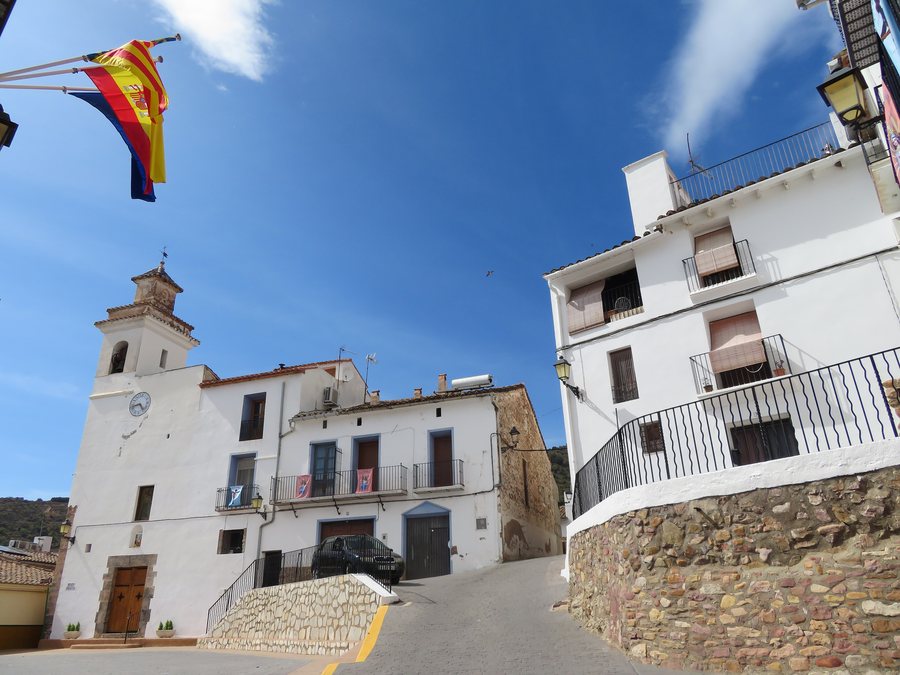 File:Iglesia Parroquial de Chóvar (Castellón).jpg
Photo: Juan Emilio Prades Bel via Wikimedia Commons, CC BY-SA 4.0
File:Iglesia Parroquial de Chóvar (Castellón).jpg
Photo: Juan Emilio Prades Bel via Wikimedia Commons, CC BY-SA 4.0
Natural surroundings with special insights
The natural side of Chóvar includes the Cueva de los Calaricos cave. Inside, it features stalactites and stalagmites. The Iberian settlement of El Rubial is also one of the recommended destinations to visit from Chóvar.
Chóvar is best explored on foot
When visiting Chóvar, walking is recommended instead of arriving by car, as many streets in the town center are inaccessible to vehicles. During a tour of the town, the walk through the center can be planned as a separate part of the day. The municipal cultural route is also of interest for your daily itinerary: it begins at Plaza de la Iglesia, leads out of the town and reaches the Pantano de Ajuez reservoir after 100 meters. This 100-meter section can be included as a short stretch between the town center and the reservoir.
A townscape shaped by Moorish influences and a mining history
The irregular street network and the irrigation system surrounding Chóvar reflect the town’s Muslim foundation and its townscape shaped by Moorish influences. Another historical focus is the area of the “el Socavón” mine. The mine entrance, spoil heaps, rails and rusted mining carts have been preserved there. Access to the mine is prohibited; the preserved elements therefore remain something to view from outside the site.
Castle remains and Santa Ana Church
The remains of Chóvar Castle consist of a watchtower complex built by Muslims. Only parts of the tower remain. The castle can be reached via a path located approximately 200 meters from the town. This approximate distance can be considered a short walking section during a tour of the town. Santa Ana Church adds another historical accent to the townscape: it was built in the 18th century and is dedicated to Chóvar’s patron saint. Its design generally follows neoclassical principles and features rich Rococo ornamentation in plaster-stucco carvings. Visitors interested in culture can consider the construction period and design details separately.
A festival in May
The Domingo de la Rosa festival in honor of the Virgen del Rosario takes place on the first Sunday in May. During the festival, the Clavarias distribute roses to residents and visitors. The first Sunday in May can therefore be noted as a fixed date when planning a trip.
Choose accommodation to match the daily rhythm
When choosing accommodation in Chóvar, the town’s daily rhythm is an important planning consideration: many routes in the center are inaccessible to vehicles, while the municipal cultural route begins at Plaza de la Iglesia. Chóvar thus provides a setting for travel plans in which you would like to combine the town’s history, the nature park, El Rubial and routes leading out of the town.
Further places for your regional orientation: Les Coves De Vinromà, Ares Del Maestre, La Llosa, El Grau de Moncofa, Vinaròs, Xilxes, Culla and Forcall.
For the broader travel overview: Castellon.

.jpg)