
Sot de Ferrer between the Palancia Valley and Sierra landscapes
Accommodation in Sot De Ferrer
Sot de Ferrer lies between the Sierra de Espadán to the north and the first foothills of the Sierra Calderona to the south. The valley of the Río Palancia runs through the municipality, enclosing the town centre from northwest to east. In this way, the town connects different landscapes with a remarkably dense succession of buildings, trails and historic sites.
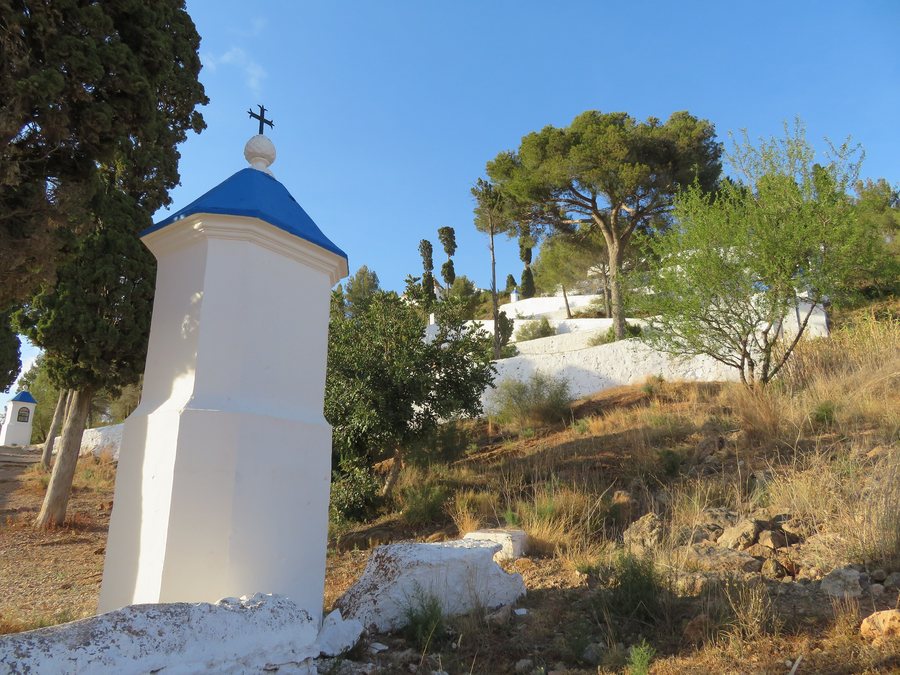 File:Capillas del Monte Calvario de Sot de Ferrer.jpg
Photo: Juan Emilio Prades Bel via Wikimedia Commons, CC BY-SA 4.0
File:Capillas del Monte Calvario de Sot de Ferrer.jpg
Photo: Juan Emilio Prades Bel via Wikimedia Commons, CC BY-SA 4.0
Landscape along the Río Palancia
The natural attractions of Sot de Ferrer include the Cueva de la Moneda. The cave has a descending gallery leading to a narrow rock fissure approximately 20 metres long. It also serves as a stopover for a migratory bat species. Those interested in river landscapes and protected habitats will find another clearly defined focal point in the Curso Medio del Palancia protected area: it is designated both as an SCI and as an SAC.
Trails for different travel plans
The SL-CV 186 runs parallel to the Río Palancia to the Iberian settlement of La Rochina and offers views of the Sierra Calderona and the Sierra de Espadán. In this way, the marked trail combines proximity to the river, distant views and a specific archaeological connection, without needing to present these elements as a single circular route.
The Vía Verde de Ojos Negros also offers various ways to experience the landscape. The Valencian section runs from Barracas to Sagunto and provides access to, among other places, the landscapes of Sot de Ferrer. The route can be used on foot, by bicycle or in a wheelchair, apart from individual ramps outside the original route alignment. This range of options is particularly relevant when planning a trip and weighing up a walk, a cycling tour or wheelchair-accessible use.
Buildings and traces of the past
The Palacio del Señor stands in the town centre at Plaza de la Iglesia. It is designated a Bien de Interés Cultural and features distinctive pointed-arch architecture from the late 13th century, with Gothic details from the 14th and 15th centuries. The Iglesia Parroquial de la Inmaculada Concepción was completed in the 18th century in the Neoclassical style. Inside is a painting of the Immaculate Conception attributed to Vicente Masip or Juan de Juanes.
The Yacimiento de Rochinas is particularly illustrative from an archaeological perspective. Its structural outlines are still well preserved despite its ruined state. The settlement on Monte de Rochinas lies in a bend of the Río Palancia; the site comprises 17 rooms connected by a central corridor and measures 35 by 19 metres.
Water engineering characterises further sights. The Acueducto de Santa Lucía channels water to the cultivated areas and crosses the Santa Lucía ravine via a round arch carved from stone. The structure is more than 600 years old. At the Molino de Calores, water was channelled to wooden paddles which, through additional mechanisms, ground the grain.
Several smaller facilities complete this picture. The Lavadero de la Rocha de la Escuela is a public washhouse on the edge of the Acequia Mayor; its roof was recently renovated. Below the Lavadero de la Luz is the village’s last washhouse, where sick people washed in order to prevent epidemics and infections among the population. The Ermita de San Antonio has been documented since the late 17th century, while construction of the Calvario on Monte de San Antonio began in 1801. Together, they form an excursion destination with extensive views.
Getting to and staying in Sot de Ferrer
Sot de Ferrer can be reached via the A-23, exit 21, and the Sot de Ferrer–Soneja connecting road. The nearest railway station is in Soneja, 2 km from Sot de Ferrer. If you are choosing a hotel for a stay combining culture, river landscapes and trails, these two arrival points provide concrete guidance for planning your trip.
Discover more places
Peníscola, Ballestar, Benicarló, Castellfort, Viver, Villafranca Del Cid, Vinaròs and Sueras
For the overarching travel overview: Castellon.

