
Bellreguard between the beach, village culture and Valencian festivals
Accommodation in Bellreguard
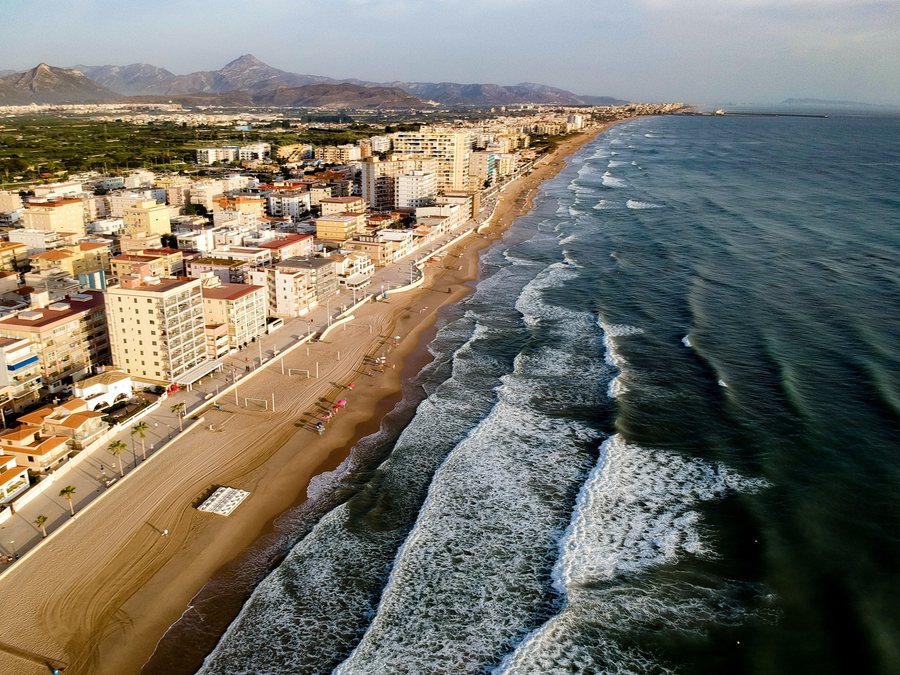
Bellreguard reveals very different sides within a compact area: La Platja de Bellreguard represents the beach, a cycle path connects Gandia with Oliva, and in the town, the church, bell tower and ceramic details tell the story of the local heritage. These are complemented by patron-saint festivals, traditional dances passed down through generations and Figatell, a characteristic local dish.
Beach and cycle path
La Platja de Bellreguard is an 800 m-long beach with fine sand and clean water. The beach has ramps and walkways for people with reduced mobility. During the summer months, there is also a bathing service for people who cannot swim independently.
Another aspect is the cycle path along the route of the former railway line. It connects Gandia with Oliva and crosses the municipality of Bellreguard a few metres from the town centre. The former railway route and the connection between the two towns give the cycle path a regional dimension, while its proximity to the town centre directly integrates Bellreguard into this route.
Church and historic details of the town
The Església de Sant Miquel was rebuilt between 1733 and 1750 in a restrained Baroque style with a Neoclassical tendency. It includes a 40 m-high bell tower with an additional 5 m-high carillon and a metal weather vane. Due to its typology and its position at the foot of the church, the bell tower is considered one of the most distinctive bell towers in the comarca.
La botigueta de Bellreguard also preserves tangible traces of the town's history. The shopfront sign was installed in 1925, when Pedro Llinares ran the business, and was made by José María Verdejo's ceramics factory. The ceramic panel and the façade of La botigueta de Bellreguard were restored at the beginning of 2021.
Festivals and traditional dances
Bellreguard's patron-saint festivals begin towards the end of September and include activities for local residents and visitors. The Sant Miquel festival is associated with the Ball de la Forca, a dance passed down through generations whose origins date back to 1861. It is performed on the eve of the Sant Miquel festival.
The Ball de la Forca uses a pitchfork as the central element of its choreography and is distinguished by the traditional Valencian dress of the rural population. The Ball de la Pandereta is a folk dance from Bellreguard, whose origins are estimated to date back to around 1820. It is performed especially during the patron-saint festivals in the town's Plaça Major. The Els Pedacets celebration currently has a strongly participatory character. Residents, cultural and festive groups, and Bellreguard Town Council all take part.
Figatell and regional cuisine
Figatell is a dish characteristic of Bellreguard. It is usually eaten as an appetiser and consists of a mixture of liver, bacon and spices, wrapped in caul fat and cooked on a griddle.
Discover more places
More destinations to discover: Camp de Túria, San Rafael Del Río, Alberic, Segart, Albaida, Piles, Benisanó, Quartell
For the higher-level travel overview: Valencia.

