
Chulilla: Rocky Landscapes, Hiking Trails and Historic Sites
Accommodation in Chulilla
Rocky Landscapes on the Río Turia
Chulilla combines striking rocky landscapes, hiking trails and a multifaceted local history. Las Hoces de Chulilla form an impressive canyon with walls up to 160 metres deep and 10 metres wide. El Charco Azul is a natural pool on the Río Turia between very high vertical rock walls. Together with the Los Calderones Municipal Nature Area, this creates a destination that closely links experiences in nature and sporting activities with the character of the town.
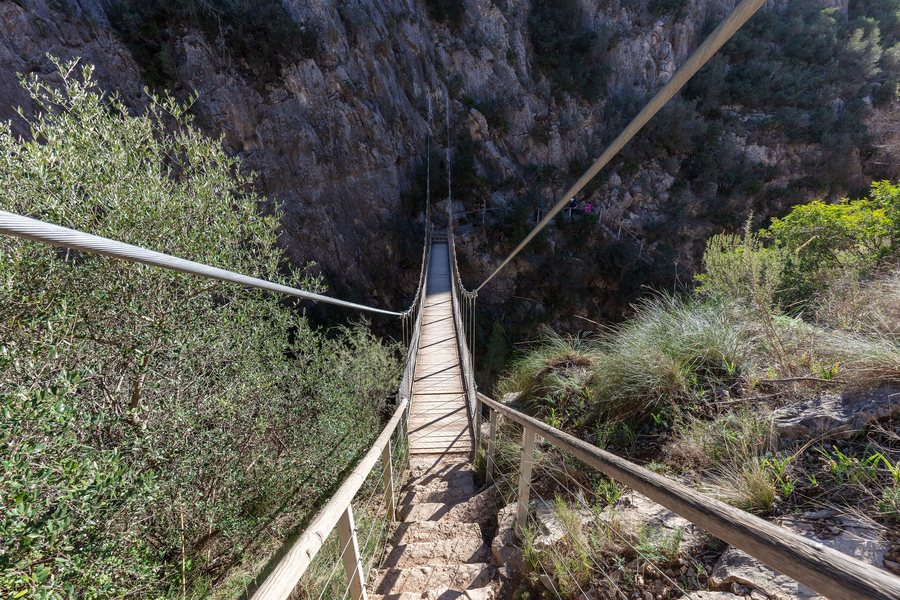 File:Chulilla, Valencia, España, 2022-12-27, DD 07-09 HDR.jpg
Photo: Diego Delso via Wikimedia Commons, CC BY-SA 4.0
File:Chulilla, Valencia, España, 2022-12-27, DD 07-09 HDR.jpg
Photo: Diego Delso via Wikimedia Commons, CC BY-SA 4.0
Climbing and Hiking
The Chulilla climbing area has long routes on vertical slabs. The Chulilla climbing school offers routes of varying difficulty and with different wall orientations. The best time for climbing in Chulilla is from October to June.
There are also clearly distinguishable routes for hiking. The PR-CV 77 is a linear hiking trail 5.50 km long. It starts at Plaza de la Baronia in Chulilla and leads through the Barranco de Vallfiguera to the Loriguilla Dam. The PR-CV 77.1 is also a linear hiking trail, 3.50 km long, and connects the PR-CV 77 with the CV-3960 road. The Barranco de la Falfiguera can be reached via the PR 77 hiking trail.
A large part of Chulilla’s climbing sectors lies within the Los Calderones Municipal Nature Area. This natural area can be reached from Chulilla via the Ruta de los Pantaneros.
Castle, Churches and Medieval Town Centre
The Castillo de Chulilla is an Islamic-origin hilltop castle. It was declared a historic-artistic monument in 1981, is open to visitors and admission is free. The municipality of Chulilla is characterised by a genuinely medieval urban structure between the Castillo and the Río Turia.
The town’s historical heritage also includes the Parish Church of Our Lady of the Angels, which was built on a mosque in the 15th and 16th centuries, as well as two religious buildings from different periods: the Hermitage of Saint Barbara dates from 1364, while the Hermitage of Saint Joseph dates from the 17th century. Among the finds at the Chulilla rock paintings is a scene with no parallels in the Mediterranean region.
Tradition and Hydrothermal Treatments
La Enramá is a traditional festival in Chulilla and takes place every year on the first weekend of May. The Balneario de Chulilla focuses on a different area, offering hydrothermal treatments such as hydrokinesitherapy, hydromassage baths, jet showers and showers in a circular cabin.
When choosing a hotel or another accommodation base for Chulilla, you can therefore tailor your travel planning to different interests: rock routes, linear hiking trails, the canyon, historic buildings, the festival date or hydrothermal treatments. The Chulilla Tourist Information Office provides comprehensive tourist information and visitor advice for the municipality.
Other places in the same selection: Piles, Silla, Burjassot, Torre Baja, La Pobla de Vallbona, Alfafar, Serra, Buñol.
To the higher-level travel overview: Valencia.

