
Valencian: The Language of Valencia Explained
Travelers encounter Valencian in Valencia on street signs, at stations, in government offices and museums, and at events. Along with Spanish, it is an official language of the Valencian Community. Spanish is generally enough for a holiday; recognizing a few Valencian words can make signs easier to understand and regional place names more familiar.
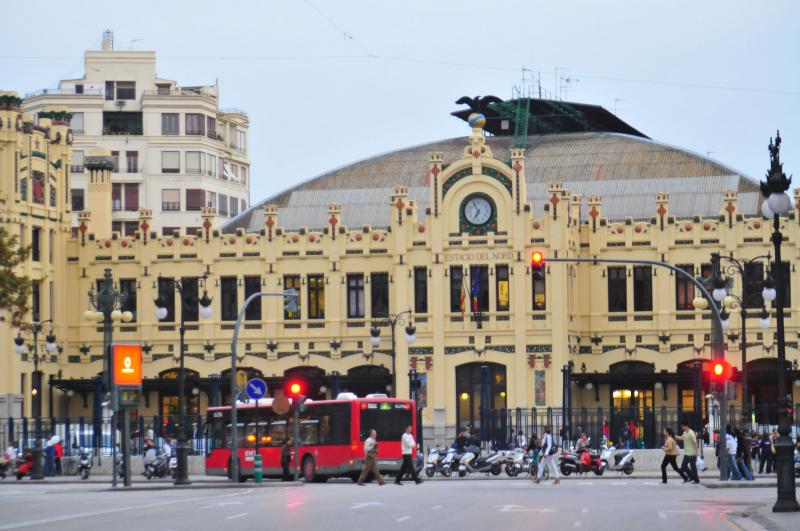 Die historische Estació del Nord in Valencia mit ihrem valencianischen Bahnhofsnamen an der Fassade.
Photo: Alesia Belaya
Die historische Estació del Nord in Valencia mit ihrem valencianischen Bahnhofsnamen an der Fassade.
Photo: Alesia Belaya
Valencian in Valencia: key facts
- Two official languages: Valencian and Spanish are both official in the Valencian Community.
- Regional differences: How often Valencian is used in everyday life varies by place, province, and personal circumstances.
- For travelers: Spanish is normally enough; English is also spoken in some tourist areas.
- Signs: Place names, street names, and public notices may appear in Valencian, Spanish, or both.
- Related languages: Valencian belongs to the same language system as Catalan, but has its own regional forms and traditions, as well as its own official name.
- Writing: Written Valencian often resembles Catalan and looks noticeably different from Spanish.
- Courtesy: A friendly “Bon dia” or “Gràcies” will be understood, but knowing these phrases is not essential for your trip.
What languages are spoken in Valencia?
Valencian and Spanish are the two official languages of the Valencian Autonomous Community. In official texts, Spanish is also called castellano, or Castilian. Both languages can be used in public life. Which language people prefer to speak depends on their region, family, schooling, work, and personal habits.
In Valencia City, visitors encounter both languages, for example on public transport, in cultural programs, and in municipal information. The language situation also varies across the provinces of Alicante, Valencia, and Castellón. Official bilingualism does not mean that everyone uses both languages equally often in everyday life.
Is Valencian the same as Catalan?
For travelers, a factual explanation is more helpful than the often politically charged debate over names. The Acadèmia Valenciana de la Llengua, Valencia’s official language academy, places Valencian in the same language system as the language known as Catalan in Catalonia and the Balearic Islands. At the same time, Valencian is the traditional and legally used name in the Valencian Community.
Regional varieties differ in pronunciation, vocabulary, and some spellings. Similar regional differences occur in other languages, too. In practice, this means that anyone who can read Catalan will understand a lot of Valencian, while Spanish-only speakers will notice clear differences.
Is Spanish enough for a holiday in Valencia?
Yes. You can normally get by in Spanish at hotels, restaurants, shops, airports, and tourist facilities. English is often also an option in popular destinations, but you should not count on it outside tourist areas. For practical planning for a trip to Valencia, a basic knowledge of Spanish is more useful than expecting to use German or English everywhere.
If you are planning a longer stay or would like to learn a language, language courses in Valencia offers information on choosing a Spanish course. Before booking, check which language is used in class and whether regional culture or Valencian-language options are included.
Why do places appear under two different spellings on maps?
A place may have both a Valencian and a Spanish name. Examples include Alacant/Alicante, Castelló de la Plana/Castellón de la Plana, and Xàtiva/Játiva. Depending on the authority, map, transport operator, or language settings, you may see one form or both. They normally do not refer to two different places.
When buying tickets, using navigation, or checking accommodation addresses, pay attention to the exact location rather than just the spelling. If you are visiting Xàtiva or another town, it helps to know both versions of its name. Accents, as in València and Xàtiva, are part of Valencian spelling, but most search fields do not require you to enter them.
Useful Valencian words for getting around
- Bon dia: Good morning or good day
- Bona vesprada: Good afternoon
- Bona nit: Good evening or good night
- Gràcies: Thank you
- Per favor: Please
- Eixida: Exit
- Entrada: Entrance
- Carrer: Street
- Platja: Beach
- Estació: Station
Words like these are especially useful on signposts and in public buildings. At Valencia’s city beach, for example, you might see platja, while eixida means “exit” at stations. It is no problem if your pronunciation is not perfect; if in doubt, you can point to the written word.
Language as part of culture and history
Valencian is not just useful for finding your way around; it is also part of literature, music, education, and regional everyday life. The history of the Kingdom of Valencia and later political changes have shaped how the language is used. The overview of the history of Valencia puts key periods in context without reducing present-day language use to a single historical conflict.
The regional language is often especially visible at festivals and public events. For help with schedules and announcements, see the overview of festivals and events in Valencia. Menus also include regional terms; the page on Valencian cuisine explains local dishes and culinary traditions.
For authoritative information on the language standard and its official status, consult the Acadèmia Valenciana de la Llengua. For official forms or legally important matters, always use the latest information from the relevant authority.
Frequently asked questions about Valencian
Do I need to speak Valencian to visit Valencia?
No. Spanish is enough for everyday travel. A few Valencian words can help you read signs, timetables, and place names.
Does everyone in Valencia speak Valencian?
No. Whether and how often people speak or understand Valencian in everyday life varies by place and person. The region’s bilingualism does not mean that every resident speaks both languages equally well.
Is València a different place from Valencia?
No. València is the Valencian spelling of the name; Valencia is the Spanish spelling and the form commonly used in English.
Why is Alicante sometimes called Alacant?
Alacant is the Valencian name, and Alicante the Spanish name, for the same city. Both forms may appear on maps and in travel information.
Is Valencian a dialect of Catalan?
Valencia’s official language academy places both within the same language system. Valencian is also the traditional and official name in the Valencian Community and has its own regional features.
What language is used on road signs and timetables?
Depending on the operator and location, notices may be in Valencian, Spanish, or both. Destinations, route numbers, and times are usually easy to identify regardless of language.
